


Scroll through social media long enough and you’ll eventually see the word “incels.”
At first glance, it can read like regular internet slang being tossed around by bored netizens. But it’s far from that.
Incels — short for involuntary celibates — are mostly heterosexual men who say they’ve been unable to form romantic or physical relationships with women despite desiring one.
These people often gather online to blame, objectify, and insult women and girls and spiral into long rants about how they’ve been dealt a bad genetic hand.
It’s easy to frame incels as simply men who can’t get dates, but the ideology goes much deeper.
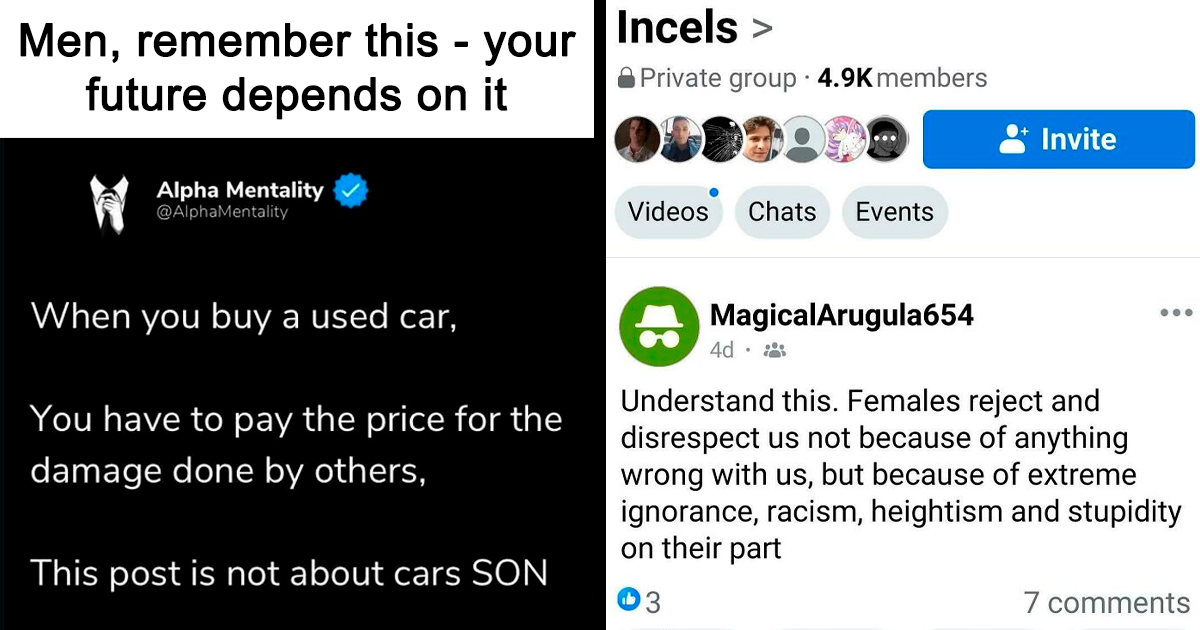
On the subreddit r/IncelTear, users collect and share screenshots of such posts to highlight just how extreme and bitter they can get.
Buckle up and hang on tight, because some of these posts get real dark, real quick.
Bored Panda also spoke to American sociologist Michael Kimmel to understand what goes on in incel communities and how to deal with them.
Before we dive in, let’s first understand where the word “incel” comes from. And what some of the incel lingo actually means.
The word originally didn’t have the angry, hateful meaning it has today. In 1997, a Canadian university student named Alana coined the term as a shorthand for “involuntary celibate.”
She created a website as a friendly space for people of all genders who were feeling lonely or had difficulty forming romantic or physical relationships.
It was meant to be a supportive place to talk about real feelings of isolation, not to attack anyone.
By 2000, the term and the community began to change as they migrated onto larger online platforms like Reddit and 4chan.
Over the 2010s, these spaces were suddenly dominated by young men who started using the word “incel” as part of a group identity — mostly expressing anger and resentment toward women and society.
Today, incel forums are full of hostile and misogynistic language, and the subculture has found its place within the broader manosphere.
Manospheres are online forums where such men openly insult feminists while claiming they are the real victims.
A study, published earlier this week, showed that 31% of men in their teens and twenties believed “a wife should always obey her husband.”
Social media has played a “huge role” in changing attitudes worldwide, the study’s co-author says.
“It is troubling to see that attitudes towards gender equality are not more positive, particularly among young men. Not only are many Gen Z men putting limiting expectations on women, they are also trapping themselves within restrictive gender norms,” says Julia Gillard, Chair of the Global Institute for Women’s Leadership, King’s Business School.
“We must continue to do more to dispel the idea of a zero-sum game in which women are the only beneficiaries of a gender-equal world. We need to ensure everyone is taken on the gender equality journey, with a clear understanding of why it benefits all of society. This report provides sorely needed knowledge on global gender equality trends,” she adds.
Online incel communities have their own vocabulary.
“Stacys” are attractive women, framed as shallow and manipulative.
“Chads” are the hyper-masculine, genetically blessed men who supposedly win all the female attention.
Anyone who tries self-improvement and succeeds is mocked as a “fakecel.”
And being “blackpilled” refers to the belief that attraction is biologically fixed — that the game of love is rigged from birth.
In these online spaces, women are often described as manipulative, mean or “money-grabbing.”
Researchers recently analyzed 3.5 million posts on a large incel forum and found that more than 80% of the discussion threads contained at least one misogynistic slur.
Over half the posts referencing women were explicitly hostile.
The dehumanizing language — terms like “foid” (short for female humanoid) — isn’t rare. It’s normalized.
On the topic of why logical arguments often fail with incels, Michael Kimmel, SUNY Distinguished Professor of Sociology and Gender Studies at Stony Brook University, says that trying to reason with members of these communities often misses the point.
“Incel culture is based on emotion, the experience of being hurt, slighted, made to feel small, and the deeper sense that you are entitled NOT to feel these things, but to be successful with women, strong, powerful, magnetic. I call that feeling ‘aggrieved entitlement.’ So, we sometimes make the mistake of telling people their feelings are wrong,” he notes.
To be clear, not every man who struggles with dating ends up in these spaces. But loneliness certainly is a recurring theme.
In one of the largest surveys of self-identified incels, 48% reported high levels of loneliness, 37% reported daily suicidal thoughts, and 86% said they had experienced bullying.
The study also showed that participants came from different backgrounds and had varied political beliefs.
“If we had to point to their most consistent characteristics, it would be incredibly poor mental health and their feelings of bitterness, frustration, and distain towards women — though even these show variation within the sample,” lead author Andrew G. Thomas, a senior psychology lecturer at Swansea University in the UK, said in a news release.
The study noted that the ‘black-pill’ philosophy — that there is nothing these people can do to improve their romantic prospects — is central to the incel belief system.
Most incels are limited to online forums, but a small minority have moved to real-time violence in the recent past.
A substantial number of them have been connected to hate crimes against women and celebrate attacks that target them.
In 2020, a Toronto massage parlor attack was ruled to be an incel-inspired act of terrorism — the first time such a crime was legally classified in that way.
In 2021, a man killed five people in Plymouth, UK. He had posted online about being “blackpilled” and engaged with incel content.
Canada, the US, and the UK now describe incel-related extremism as an emerging threat category.
“While most incels will not perpetrate a mass shooting, the toxic collision of aggrieved entitlement and the easy availability of guns suggests that without significant changes in masculinity, the tragedies will continue,” writes Ross Haenfler, associate professor at Grinnell College.
Some experts believe that incels are part of a larger backlash against changing gender norms.
As women, LGBTQI people, immigrants and people of color gain more visibility and representation, some men experience that shift as a loss.
These posts also show that incels mostly blame feminism for everything from declining birth rates to men’s mental health struggles.
It’s easy to frame incels as simply men who can’t get dates.
But this culture reflects how we still define masculinity — by power, conquest, status and comparison.
It basically casts women as gatekeepers of male worth.
Their language may sound like meme culture, but the harm that comes with it is very, very real.


0 Comments