


You’re at the playground. Your toddler is shrieking with joy near the swings. You sit down on a bench, and another parent sits beside you. They look tired—but it’s the good kind of tired, the kind that comes from loving someone tiny and full of energy. You want to say something…but what? Should you ask how old their kid is? Or whether they’ve figured out how to get ketchup stains out of everything yet?
You say nothing, and pull out your phone instead. They do the same. Five minutes later, you leave without saying a word and feel more alone than ever.
Sound familiar? You’re not alone. A staggering 62% of new parents report feeling lonely or isolated at least some of the time, according to new research from the National Childbirth Trust (NCT). Nearly nine out of ten parents feel overwhelmed, and almost a quarter say they lack a strong support system.
Modern parenthood wasn’t meant to feel this way. For many, it does.
In response, English Heritage, the charity that manages over 400 historic sites across England, has introduced a simple, beautiful idea to help. They’re called “bonding benches.”
A bench that works for you
Here’s how it works: bonding benches are being installed at castles, abbeys, and gardens—places where families tend to gather. They’re strategically placed near playgrounds and open grasslands, as well as other spots where parents take a moment for themselves while their kids burn off energy. But these are not ordinary benches.
Each bench has a small slider that you can switch between two settings: “up for a chat” or “craving quiet.”
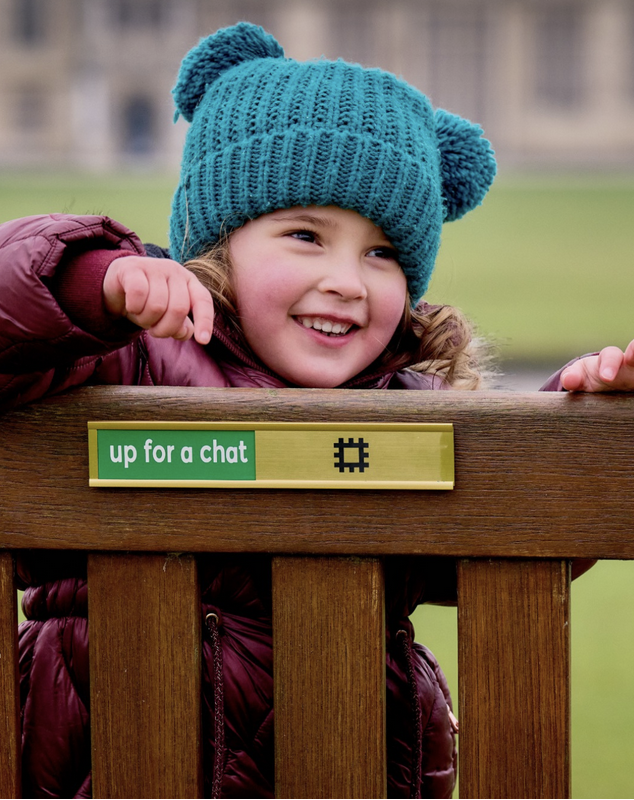
That’s it. No apps, no awkward eye contact, just a small piece of plastic that shows other parents how you’re feeling in that moment—and whether you’re open to talking.
Emma Fernandes Lopes, assistant operations director at English Heritage, explains the reasoning behind it:
“As parents, we are hardwired to prioritize our children’s wellbeing. We bring them out to wonderful places like English Heritage sites to explore the outdoors and expand their horizons. But we often forget that the key to children’s wellbeing is actually found in whether their parents feel happy and supported.”
She continues, “Modern parenthood can be a really isolating experience. Many parents live a long way away from their extended families and have no support network to lean back on, and it’s often a real challenge to make friends who hold the same values and interests.”
The benches were launched in February 2026, ahead of the United Kingdom’s half-term holidays. They are now available at popular sites including Kenilworth Castle, Bolsover Castle, Wroxeter Roman City, and Witley Court and Gardens.
Why this matters more than you realize
The statistics behind this initiative are eye-opening. The NCT’s research, which surveyed 2,000 new and expectant parents across the UK, found that 87% feel overwhelmed at least some of the time. More than one in five (23%) did not have a positive feeding experience. And 23% said they lacked a strong support system.
But what makes parental loneliness so insidious? The shame that accompanies it.

Research from the UK government’s loneliness stigma assessment found that people experiencing loneliness often feel embarrassed or worry they’ll be judged if they admit it. Parents, in particular, fear being labeled as “bad” or “inadequate” if they reach out for help. As a result, they don’t. They withdraw instead, which only deepens their feelings of isolation.
For mothers and fathers who have moved away from family, whose friends don’t have children yet, or who feel out of step with the current parenting culture around them, the loneliness can feel overwhelming.
More than just a bench
English Heritage is expanding beyond benches. The charity has partnered with the NCT to bring their popular “Walk and Talks” to selected sites—free, volunteer-led walks designed for parents with strollers, slings, and young children. These walks are taking place at Audley End, Kenwood, Marble Hill, Wrest Park, and Kenilworth Castle, with plans to add more locations.
Families can also pick up an “Adventurer’s Checklist” at any site, a free list of 25 fun activities for young children. Imagine splashing in puddles, spotting signs of animal life, and making silly sounds in echoing places. The tasks are meant to encourage interaction among families who might not usually connect.
Depending on the site, there are also playgroups, chatty cafes, and children’s crafting sessions. All are created to give parents low-pressure ways to connect.
The secret: Low-pressure connection
The genius of bonding benches lies in what they don’t do.
They don’t pressure you to start conversations. They don’t expect you to “put yourself out there”—a vague and somewhat intimidating phrase for many. Bonding benches invite parents to sit and honestly assess whether they have the energy to talk or would rather enjoy five minutes of silence while their kid digs a hole with their bare hands.
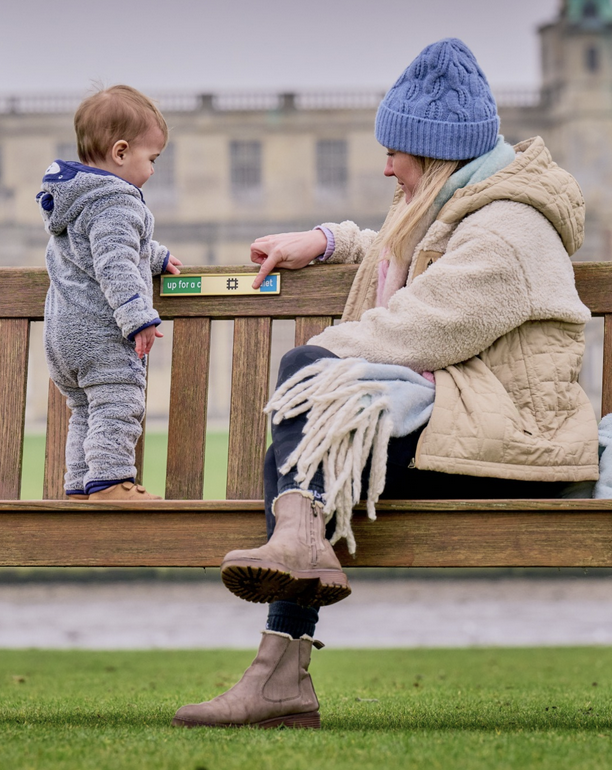
That simple permission matters. It’s not that adults don’t want to make friends; they do. But there’s a common fear of rejection. We dread the small talk and worry we’ll seem eager, needy, or weird.
The slider eases all that pressure. If someone sits next to you and moves their marker to “up for a chat,” they’re giving you the go-ahead. You don’t have to guess or act. Just say hi.
But if you need quiet, you can signal that too without feeling guilty or apologizing.
The bigger picture
Parenting shouldn’t feel this lonely.
For years, anthropologists and evolutionary biologists have been saying humans did not evolve to raise children in nuclear families.
Among the Aka people of Central Africa, an infant typically has about 20 different caregivers, including extended family, neighbors, and other community members who help with child-rearing.
But in the Western world, we’ve narrowed caregiving to just one or two exhausted adults. Parenting has become a private matter, yet we still wonder why parents are tired, lonely, and overwhelmed.
English Heritage’s initiative won’t fix that structural problem. But it’s a meaningful step in the right direction. It reminds parents that connection is still possible, even in small moments. It sends a message: reaching out to others doesn’t make you weak—and you’re not the only one craving closeness.
What happens next?
The bonding benches are now live, and early feedback has been positive. Parents on social media have praised them, calling the benches “brilliant,” “exactly what we need,” and “such a simple but powerful idea.”
However, the true test will be whether they can make a lasting impact, measured by parents using them, conversations taking place, and friendships forming.
Another important question: will other organizations develop their own versions of the bonding bench? If a historic charity that manages medieval castles can recognize that modern families are struggling—and take action—the hope is that others will do the same.
If you’re in England and want to find your nearest English Heritage site with a bonding bench, visit its website. If you’d like to volunteer as an NCT Walk & Talk leader, you can find out more on its website.
Next time you’re at the playground, find the bench. Feeling brave? Move that marker to “up for a chat.” You might be surprised who also slides theirs up.


0 Comments