

A new trend is sweeping the Internet, and it goes something like this: A person posts a TikTok. They say they’re doing a “sprint month.” Then they disappear and return a few weeks later with a follow-up video. They’ve transformed. They’re calmer, more focused, and, in a weird way, more themselves. The comment section goes appropriately wild.
In May 2025, TikTok user Kelli (@growwithkelli) shared a video titled “A Sprint Month Changed the Trajectory of My Life,” which garnered over 58,000 likes and has been viewed nearly 700,000 times. In it, Kelli explains the sprint month phenomenon: “A few months ago, I did what’s called a ‘sprint month,’ and it absolutely changed the trajectory of my life. I feel like I’ve jumped timelines into becoming a different version of myself.”
“A sprint month is basically a process where, for thirty days, you become the person you want to be. You act as that person. Before long, you start to notice all the excuses you’ve been using for so long that have prevented you or stopped you [in the past]. For thirty days, you put those excuses to the side, and you sprint towards ‘the goal’ or the one thing that you know will move your life in monumental ways.”
– Kelli
She goes on to detail her sprint month goals (technically, “sprint months”—Kelli kept this going for two consecutive months): she wanted to eat healthier, show up more at the gym, and pursue her passions outside her nine-to-five job.
Yes, you can accomplish a sprint month while holding down a full-time job.
This is more than a social media fad: it’s a certified movement supported by leading psychology. There’s a reason this concept has connected with hundreds of thousands of people on TikTok, Instagram, and wellness blogs. Sprint months tap directly into how our brains process time, motivation, and personal transformation. And we’re sharing the secrets to running your sprint month safely, the history of the trend, and the psychology of “locking in.”
The Internet’s reaction
Kelli finished back-to-back sprint months while holding down a full-time job. Seems like a lot, right? That’s exactly the point. In her viral video, she goes on to detail the positive effects she noticed during her sprint months: “When you start acting in alignment with who you feel like you’re meant to become, it creates this ripple effect in every area of your life.”
She provides examples: Over the past few months, she’s landed a job that’s more aligned with her personal passions. She started a social club that’s improving every day. Her anxiety softened. Her relationship with her partner improved. The best part? Those weren’t even her sprint month goals.
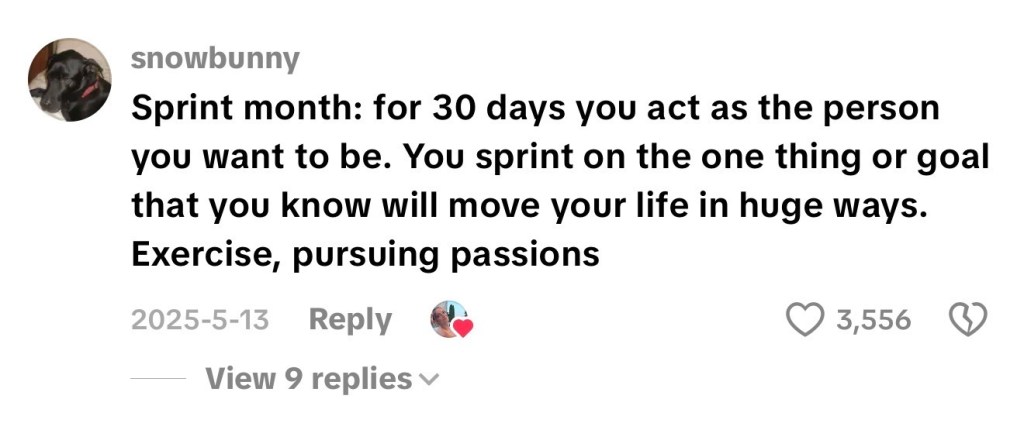
“These things happened, even though I wasn’t prioritizing those specific [areas],” says Kelli. “I was just focusing on a few key areas. That’s the power of a sprint month.”
Kelli’s comment section erupted, with other users chiming in with their own sprint month experiences. “I did that for a couple of months, and now I’m living in France in my dream apartment,” wrote one commenter. “The less you resist, the more you receive!” chirped another.
Hollie Fleischman (@hmfleischmann) wrote: “I saw your video and did one in March, and continue to do one every month. March was weight loss, April was studying for my certificate, and May is my financial month! I’ve lost over 25 pounds since then and saved over $3,000! Thank you for the idea!!”
Kelli isn’t alone. Search “sprint month” on TikTok, and you’ll find hundreds of videos—made overwhelmingly by young women—showing how they drastically changed their lives in just 30 days.
In a video titled “A Sprint Month could change your life,” Grace (@graciesecrist) shared her sprint month wishlist with the platform. “I’ve seen people posting about [sprint months] before, and I would always think, ‘Oh, I’ll start on the first of the month,’ or, ‘I’ll start on a Monday.’ But I need to stop making excuses for myself. Because at the end of the day, I’m only wasting more time,” she tells viewers. She’s aiming to walk 10,000 steps per day, break her doomscrolling habit, and explore New York City.
For people who don’t know where to start, a video posted by Kelly Matthews (@kellylmatthews) details a general template designed for those who want to “accelerate the timeline” toward becoming a different person. She recommends aiming for 10,000 steps a day (8,000 minimum), planning three gym sessions a week (and putting them on your calendar ahead of time), eating one gram of protein per pound of body weight per day (plus 25 grams of fiber), and putting your phone away half an hour before bed.
She ends the video with a challenge. “So what’s it going to be?” she asks. “Are you going to walk towards the goals you have? Or are you going to sprint? 30 days. That’s it. We can do it.”
From software teams to your TikTok For You Page
“Sprint months” didn’t come from the self-help world. The term “sprint” is actually lifted from Scrum, an agile project management framework developed for software engineering in the early 1990s. In the Scrum Guide (which details the product’s accountabilities, events, artifacts, and rules), co-creators Jeff Sutherland and Ken Schwaber define a sprint as “a fixed-length event of one month or less.” Sprints are designed to give developers a clear goal, a set timeframe, and an opportunity to review progress at the end.

Sprints entered the personal growth stratosphere when productivity writer J.D. Meier introduced the “Monthly Improvement Sprints” method. Instead of chasing a single long-term goal, his personal growth framework centers on a series of twelve monthly themes each year. “This way, each month would be a fresh start,” he writes. “What I generally notice is that a lot of the hurdles I hit in my first week are gone by week 2. Little improvements each day add up quickly.”
Meier adds suggestions for sprint month themes:
- Make progress on a dream (chip away at a big dream or [invent] a little dream and make it happen).
- Sharpen a skill.
- Try your hand at something new.
- Reshape your body.
- Adopt a new habit.
TikTok users discovered this framework and, no pun intended, ran with it. Creator @kellylmatthews pumps up sprinters in her viral clip:
“For thirty days, you’re not going to walk towards your goals. You’ll be sprinting towards all the things you want to accomplish this year. This isn’t about toxic hustle culture. It’s not ‘I’ll sleep when I’m dead.’ It’s about increasing the amount of work that you’re willing to put in.”
Why 30 days hits that perfect sweet spot
Besides glowing anecdotes and enthusiastic letters of recommendation, there’s a decent chunk of psychology and science backing 30-day sprints. The “Fresh Start Effect” helps explain the psychology behind sprint months and why this 30-day challenge feels so motivating. Researchers from the Wharton School found that people are more likely to work toward their goals after a “temporal landmark,” like the start of a new week, a birthday, or the first of the month.
Temporal landmarks provide us with a mental clean slate. They are moments that help us distinguish our “past self” (who might feel discouraged by past struggles or perceived failures) from our “future self,” whom we believe will succeed. A sprint month transforms the beginning of the month into a portal: accept the challenge, and you’re given a fresh opportunity to embody the person you’re meant to become.
Laurel van der Toorn, a therapist and clinical director at the Laurel Therapy Collective, further demystifies the magic behind the 30-day window:
“While consistency over time is important, we can’t always put considerable effort toward one thing for a year. Having a clear start date and a clear end date enables us to push more than we usually would on something. The structure and containment of sprint months is what makes them so powerful and useful.”
But the psychological trick that makes 30-day sprints feel like productivity sorcery lies in the speed at which you see results. Research by Ayelet Fishbach and Kaitlin Woolley at the University of Chicago Booth School of Business found that immediate rewards are a more powerful motivator for goal persistence than delayed outcomes, even more than how much someone values the goal itself.
While we normally pursue long-term goals (like exercising) to receive delayed rewards (like improved health), that mindset can be counterintuitive. Fishbach and Woolley found the opposite: immediate rewards—such as enjoyment, fun, or positive experiences—better indicate whether a person will stick with an activity. Immediacy creates a perceptual fusion between the activity and its reward, linking the two. In the context of “sprint months,” when you see results in such a short time span, your brain begins to associate your progress with pleasure. The activity itself—whether it be working out, eating better, or lowering your screen time—starts to feel rewarding. That’s incredibly powerful.
A daily feeling of achievement, a visible streak on a tracker, or encouragement from a TikTok accountability group can all act as immediate rewards that help keep motivation high.
How sprint months compare to other viral challenges
You may not have encountered sprint months before, but you’ve likely heard of their buddies: “75 Hard,” “The Winter Arc,” and “The Great Lock-In.”
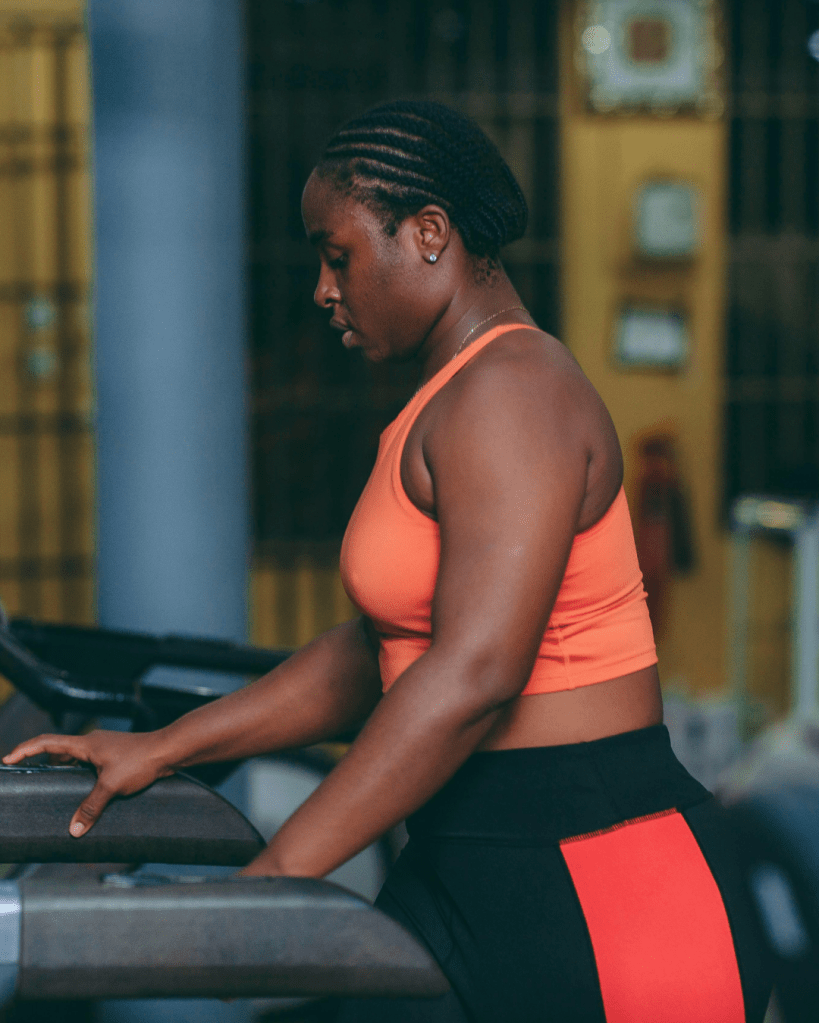
Sprint months don’t exist in a vacuum. They’ve emerged as part of a rising trend of short-term self-improvement challenges popular among Gen Z and Millennials.
75 Hard, created by entrepreneur Andy Frisella, is a grueling program in which participants must complete five intense daily tasks for 75 consecutive days: two 45-minute workouts (one outdoors), drinking a gallon of water, following a strict diet with no cheat meals or alcohol, reading 10 pages of nonfiction, and taking a daily progress photo. If you miss a single day, you have to start over.
“This is not a fitness challenge,” Frisella warns on his website. “I spent years feeling like I was nothing, trying program after program to get back on track…only to fall off right after I completed it. Then I realized that the root cause of all my problems was not addressed by any existing program.”
The Winter Arc rose to fame on TikTok in late 2024. This self-improvement trend avoids the “new year, new me” trap and urges people to jump-start their personal growth well before the ball drops on January 1. Miami-based influencer Carly Berges (known as @carlyupgraded) is widely credited as the creator of the Winter Arc; her TikTok about it has garnered over 4.8 million views.
“If you’re seeing this video before October 1st, then you are just in time for your Winter Arc,” says Berges. “This is a time where people tend to let their foot off the gas, but there are still three months left in the year.” She goes on to reframe October, November, and December as an opportunity to “dial the f*** in” and get serious about your personal transformation goals.
Unlike the severity of 75 Hard, the Winter Arc has no fixed ruleset. Instead, participants typically build a personal list of around 10 daily self-improvement habits they commit to for the duration, usually spanning fitness, sleep, mental health, nutrition, and relationships. The hashtag #winterarc quickly climbed to fifth on TikTok’s U.S. trending chart, accumulating over 250,000 videos.
Finally, there’s the Great Lock-In, which also encourages people to “follow specific regimens for shorter bursts of time in hopes that they will be more likely to meet their goals.” In her video, “Building self-trust step-by-step for lasting change,” Kadie Glenn (@kadieglenn) outlines the trend’s parameters, which are noticeably more relaxed than those of 75 Hard:
- Start with small actions you can consistently show up for.
- Track your wins visibly and daily (Glenn suggests using a daily habit tracker or sticky notes).
- Adopt the “never miss twice” rule. You can skip one day, but never miss two. Create friction for bad habits (removing harmful apps from your phone, for example) and enable flow for desirable ones (like laying out your gym clothes the night before).
Writer Cal Newport noted that “lock in” was voted the “most useful” term of 2024 by the American Dialect Society, stating that the concept reflects Gen Z’s desire for undistracted focus amid constant notifications.
In comparison to their counterparts, sprint months are shorter and more focused. These 30-day challenges are meant to be more accessible, and missing a day (or two!) doesn’t mean starting over, which provides a more realistic way to build habits.
The part no one talks about: Burnout
Now the not-so-fun part. When pushed to the extreme, sprint months can be dangerous, and it’s important to recognize that.
Dr. Meghan Marcum, chief psychologist at AMFM Healthcare, warns participants not to slip into all-or-nothing perfectionism. A single missed day should not feel like a total failure. Clinical psychologist Jamie Evan Bichelman echoes this: “Where this trend could become unhealthy is the act of comparison: seeing influencers who obsessively post about their progress…and comparing their achievements to your busy life.”

Research consistently shows that sustained effort over time leads to lasting change rather than a single spurt of intensity. A 2024 study found that long-term transformation results from “two to five months of small, consistent actions, not a frantic three-week sprint.” Keep that in mind before hopping on this trend.
How to build a sprint month that works
Still up for the challenge? Here’s a sprint month template that’s backed by psychology and self-development research:
- Choose a single goal that feels meaningful and somewhat uncomfortable. Start with just one, not five.
- Get clear about your definition of “success.” What does being “done” look like on day 30?
- Establish short, achievable minimums for tough days. Even five minutes spent toward your goal counts. Remember that perfection isn’t what you’re after, and be gentle with yourself.
- Break your sprint goal into daily actions with a specific time and place. Prioritize these actions in your schedule.
- Include an immediate reward during or after your daily action. It should be enjoyable, like listening to a favorite song, having a good coffee, or taking a walk outside.
- Track your progress. Use a wall chart or journal: a visible streak reinforces motivation and momentum better than digital apps or nothing at all.
- Be honest in your assessment on day 30. If you’re burned out, take a break; you’ve cleared the hardest hurdle. If you remain energized, keep going.
- If the habit sticks, why stop? Keep in mind it may take up to two months (66 days) to reach true habit automaticity.
The momentum lives beyond the month
Here’s a truth that gets overlooked: the 30-day sprint isn’t the finish line. It’s just the beginning.
The feeling you get when you complete a goal, or set your mind to something—and achieve it—feels like magic. But in reality, it’s the logical result of a combination of structure and intent. Yes, a concentrated 30-day effort builds the type of momentum needed to push through initial resistance. However, the habit won’t be second nature—not yet. But you’ve already done the hardest part: showing up.
Sometimes, that’s exactly the start you need.


0 Comments