


Continuing this series. You can read the first part here and the second part here.
Bob Kane, obviously with a lot of help from others, drew the earliest Batman stories. Soon though, he was easing into a life he’d read about and dreamed of…the life of a syndicated cartoonist. He wasn’t one then but he’d read the success stories and it sounded like a great thing to be. It was what almost all the men who got involved in the earliest days of the comic book industry dreamed of.
One example of many was Bud Fisher, the creator of one of the most popular comic strips of its day, Mutt and Jeff.
Harry Conway “Bud” Fisher was a sports cartoonist who segued into drawing a daily newspaper strip. At first, it was called A. Mutt and it featured Augustus Mutt, a lanky racetrack frequenter who’d popped up in Fisher’s sports cartoons. In fact, it debuted on the sports page of The San Francisco Chronicle on November 15, 1907. Four months later, the Jeff character turned up in the strip and stayed forever. And then a few months later, the strip began national syndication and became a huge hit.
There were articles and radio shows that talked about Bud Fisher…about the (then) astronomical sums of money he was making…his penthouse apartment…his cars and limos and the fancy restaurants at which he dined. He was a true celebrity of his day. If you were a kid living in near poverty but able to draw a little, how could you not fantasize about that as your life’s work? What else could you aspire to that could be better?
Breaking into and succeeding in the world of syndicated newspaper strips was and still is very, very difficult. It’s almost like saying, “You know what I’ve decided to do with my life? I’ve decided to win the lottery!” But there was a time in the late nineteen-thirties when comic books (as opposed to strips) came along and publishers needed pages filled. It wasn’t that hard to get work doing that. You might be inking backgrounds or lettering but there were jobs there and doing them felt kinda like doing what Bud Fisher did. It just didn’t pay as well…yet.
Bob Kane wasn’t Bob Kane at the time. He was Bob Kahn, a guy who could draw a little. Over the years, I asked a number of men who worked with him — men like Jerry Robinson and Sheldon Moldoff — if Kane had any real native talent for drawing. Or was it a matter of him never doing enough of it to improve much? Both of those former assistants said it was both. And both said that if Bob had any ability at the drawing board, it was for more humorous material. But DC was looking for a new strip like Superman so Bob Kahn, who’d started signing his work “Bob Kane,” whipped up, with the help of a friend, that kind of strip.
That wasn’t so unusual. You go where the work is and you try to do it the way the folks with hiring power want it done. I have a theory that an awful lot of guys who could have been different kinds of artists with unique styles didn’t because they spent way too much of their lives drawing the way DC or Marvel or some company wanted. Kane went where the work was and hired assistants to help because he didn’t draw that kind of material particularly well and also maybe because he was lazy.
So Kane did hire assistants the same way Bud Fisher — and about 80% of all the successful syndicated cartoonists — hired assistants. Actually, Fisher didn’t even do that sometimes, leaving it to his syndicate to recruit artists to work on Mutt and Jeff. They included Ed Mack, Ken Kling, Bill Liverpool, George Herriman and Maurice Sendak. Yes, that’s the same George Herriman who went on to create Krazy Kat and yes, that’s the same Maurice Sendak who went on to create Where the Wild Things Are and other wonderful non-wild things.
There are two guys who created their own, unique (and wonderful) work. That was because they didn’t spend their lives trying to draw what someone else wanted them to draw in the style of someone else.
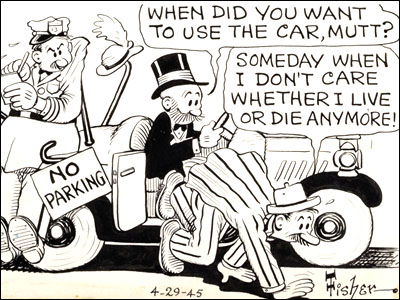
Meanwhile, the guy who assisted the longest was a gent named Al Smith and come to think of it, Smith really wasn’t an assistant. A better job description of what he did would be Ghost. Al Smith ghosted the Mutt and Jeff strip for 48 years. That is not a typo. He began in or around late 1932 and before long, he was writing and drawing the strip himself and Fisher was doing none of it. The only drawing Fisher would do would be when he made personal appearances or when a pretty lady would approach him in some swank restaurant and ask for a quick sketch. Smith did the whole strip including the part where he signed each one “Bud Fisher.”
Smith even signed “Bud Fisher” on the strip for a few months after Bud Fisher died in September of 1954. It finally said “Al Smith” on it as of December 7, 1954 and Smith continued to draw it until 1980.
Why am I spending so much of this piece on Mutt and Jeff? Because the life of Bud Fisher was what Bob Kane and — let’s face it, other guys who got into comic books in the first decade or two of the medium — wanted. The second time I met Kane, I had what was, for a kid my age, a surreal experience. I spent maybe ninety minutes with him in his apartment on Wilshire Boulevard in West Los Angeles, watching him consume vodka and listening to him ramble on about his life and the comic book industry…and yes, he did mention how much he wanted to grow up and be Bud Fisher.
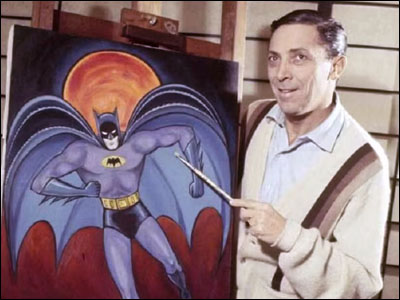
And he talked about his “assistants” — that’s what he called them. My first visit with him was a week or two earlier and I’d taken along the then-current, just-published issue of Batman without realizing the significance it had in his life. It was the first issue where the art, done by others as it had been for decades, was not credited spuriously to Bob Kane.
I’ve written before here about those visits and a few other encounters I had with the man and I’ve been asked a lot of questions about him. I feel like I oughta go into greater depths about what I learned and I will in the next few parts of this series. And we’ll even get to the part about a man I also met, albeit ever so briefly, that friend who helped him create Batman.


0 Comments