


Fashion is timeless and some styles from way back still manage to steal our hearts today. Whether it’s a lace-trimmed gown, a string of pearls, or a perfectly embroidered glove, the elegance of the past continues to inspire.
Today, we stumbled upon a delightful Facebook group that celebrates just that. It features fashion, jewelry, decor, photos, and more from eras spanning ca. 1101 to 1960. Each photo feels like stepping into another time, a quiet, graceful world shaped by resilience, romance, and artistry. It’s not just about style; it’s about stories. So go ahead, take your time, soak in the beauty, and keep scrolling. You might just fall in love with a decade you never lived in.

Heinrich Gogarten (1850-1911) was a 19th-century landscape painter known for his mastery of winter scenes. He was born in Linz am Rhein. He studied at the Dusseldorf Art Academy under the renowned painter Oswald Achenbach. Most of his works are in private hands.
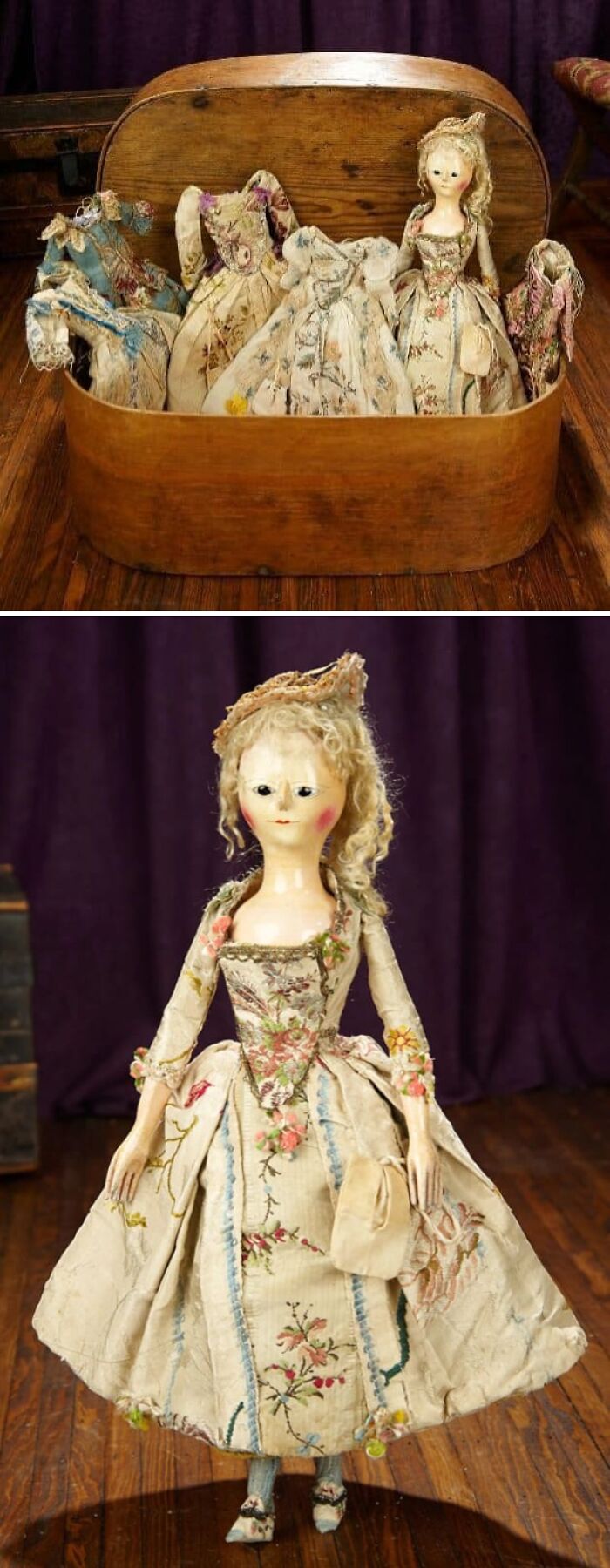
All carved wood with one-piece torso and egg-shaped head, elongated curved throat, shapely bosom, flat back, black enamel inset eyes, “dot” painted all-around lashes and wide brows, tiny pointy nose with accent dots, thin line lips with center detail, cheek blush spots, blonde delicate mohair wig on original linen cap, cloth upper arms, carved wooden lower arms with fork-shaped fingers, wooden legs with jointing at hips and knees. – Theriaults
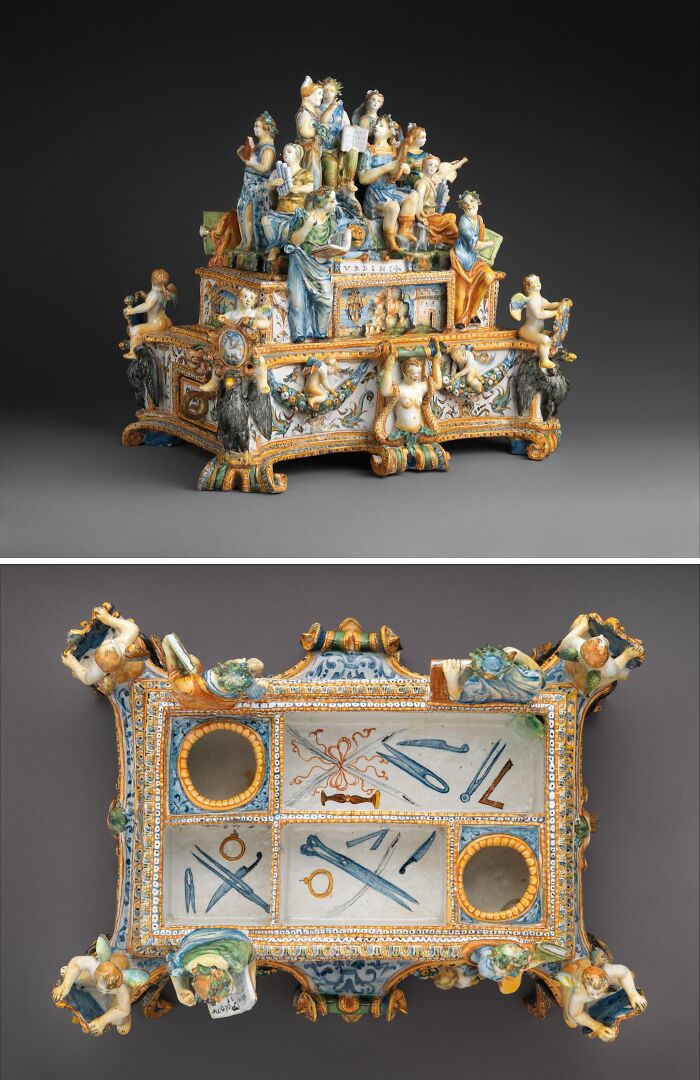
This extravagant desk set celebrates the art of poetry while providing a writer with storage for the tools of his craft. The exterior decorations evoke ancient Roman art and honor the divine sources of creativity. Gods and muses perch beside famous poets atop an elaborate confection of drawers and removable containers, including inkwells and a sand-shaker (for drying fresh text). Inside, the compartments are decorated with images denoting their contents, such as scissors and quills.
There’s just something magical about vintage jewelry, right? The kind of sparkle that makes you feel like royalty the moment you put it on. Back in the day, there was an undeniable sense of grandeur, jewelry wasn’t just pretty, it was powerful. From the delicate craftsmanship to the bold designs, every piece told a story. It was less about matching your outfit and more about making a statement without even speaking.
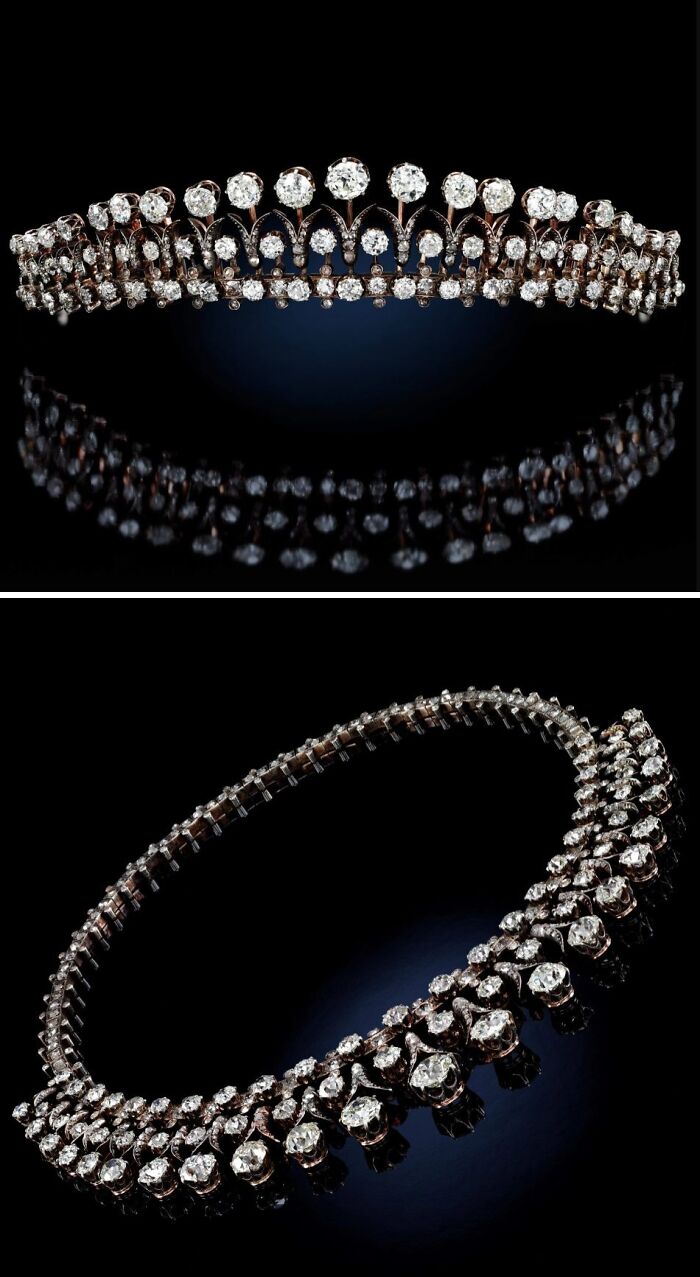
Designed as a relatively short compact fringe, the slightly tapered form composed of 23 knife-edge bars each applied with a curved V-shape diamond-set motif and surmounted by an old-cut diamond in claw setting and interspersed with shorter bars topped with graduated old cut diamonds. All are set above a base row of diamonds with alternate stones embellished above and below with a bezel set rose-cut diamond. All diamonds set within the frame in silver and gold. The tiara converts into a necklace whose back chain is fully set with rose-cut diamonds and adjusts in length to be worn as a bracelet, with French assay marks, inner length of tiara approximately 340mm, length of backchain approximately 200mm.
Total weight approximately 32cts
Comprising:
376 x old-cut and rose-cut diamonds estimated to weigh an approximate total of 32cts
Largest central old cut diamond estimated to weigh approx. 1.6ct.
Then came the 1960s and everything got loud, proud, and fabulous. Jewelry took center stage like a scene-stealer in a movie. Women weren’t just accessorizing, they were showing off their sass and style through bold, oversized pieces. Think chunky necklaces, loud cocktail rings, and unapologetic glitz. The energy of the decade oozed into every jewel box, and honestly, modern fashion owes it a thank-you card.
One of the coolest things about ’60s jewelry? Shapes. Geometric shapes were everywhere. Triangles, circles, rectangles, you name it, someone was wearing it on a pendant. These clean, angular designs gave off major modern-art vibes. Add in some colorful gems or shiny metals, and suddenly your necklace was basically its own little gallery show.
What’s fun is that the 1960s had a split personality when it came to color. On one hand, you had super sleek black and white pieces that looked like they belonged in a fancy Paris café. Checkerboard earrings? Yes please. Zebra-stripe bangles? Absolutely. Then on the other hand, things were colorful. We’re talking pretty pinks and screaming yellows. It was wild and wonderful.
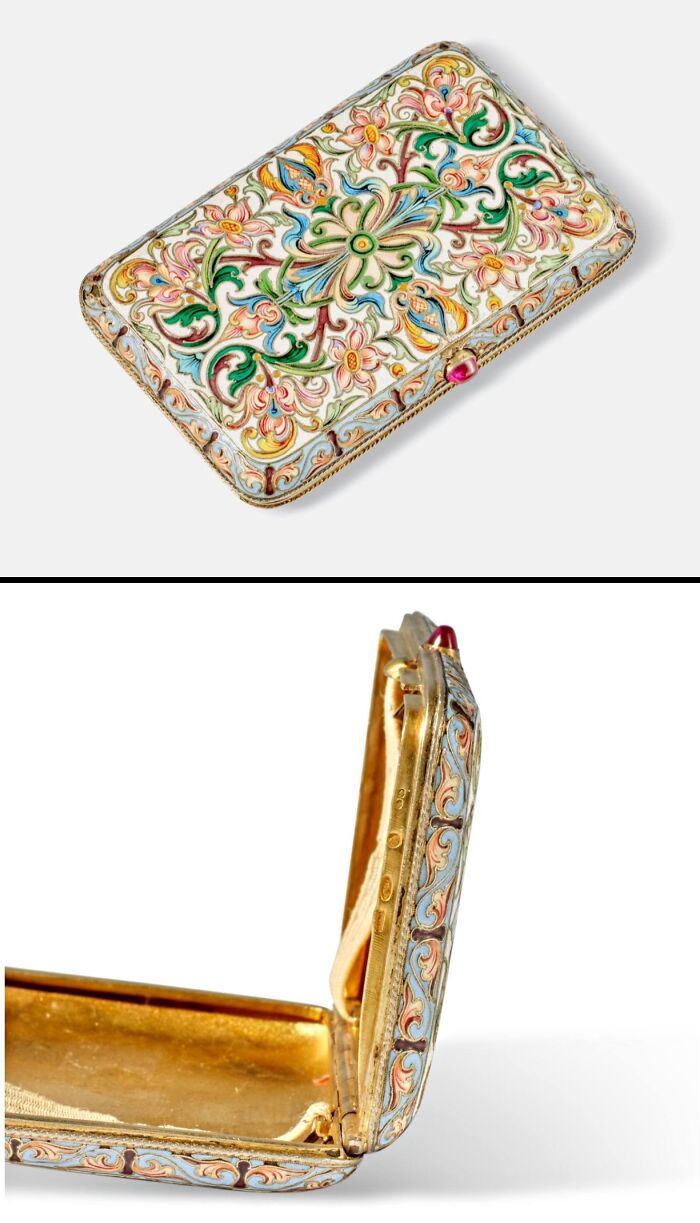
The surface is enamelled throughout with scrolling foliage and flowers in shaded pink, blue green, yellow, and translucent green over an opaque white ground, within powder blue borders similarly enamelled in a conforming style, with a cabochon ruby push-piece, struck with workmaster’s initials, 88 standard
width 10.5cm; 4 1/8 in.
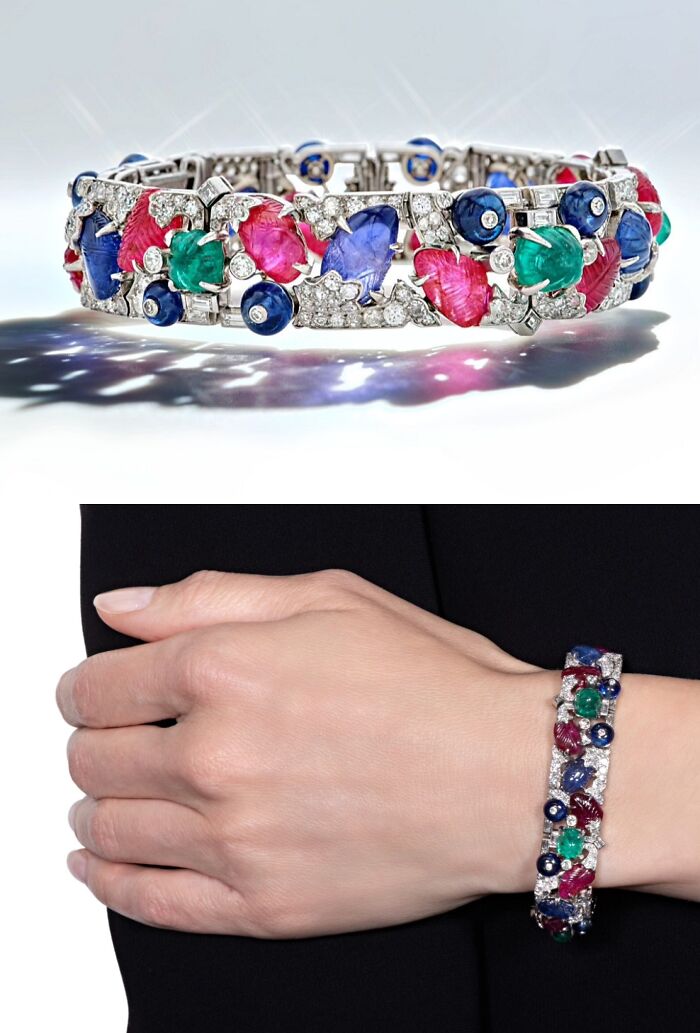
The openwork band of foliate design, set with carved rubies, sapphires and emeralds, accented by sapphire beads, decorated with variously cut diamonds, length 7 inches, signed Cartier Made in France, with French export and workshop marks; circa 1930.
Coming up for auction estimate USD 300,000 -USD 5000 Sotheby’s 5 December 2023
I watched it sell live for 508,000 USD
Of course, you can’t talk about ’60s style without mentioning the hippie influence. With flower power blooming all over the place, jewelry designers got inspired by nature, big time. Leaves, petals, and all things earthy started popping up in designs, often in vibrant, colorful ways. It wasn’t just about looking pretty; it was about feeling connected to something real and raw.
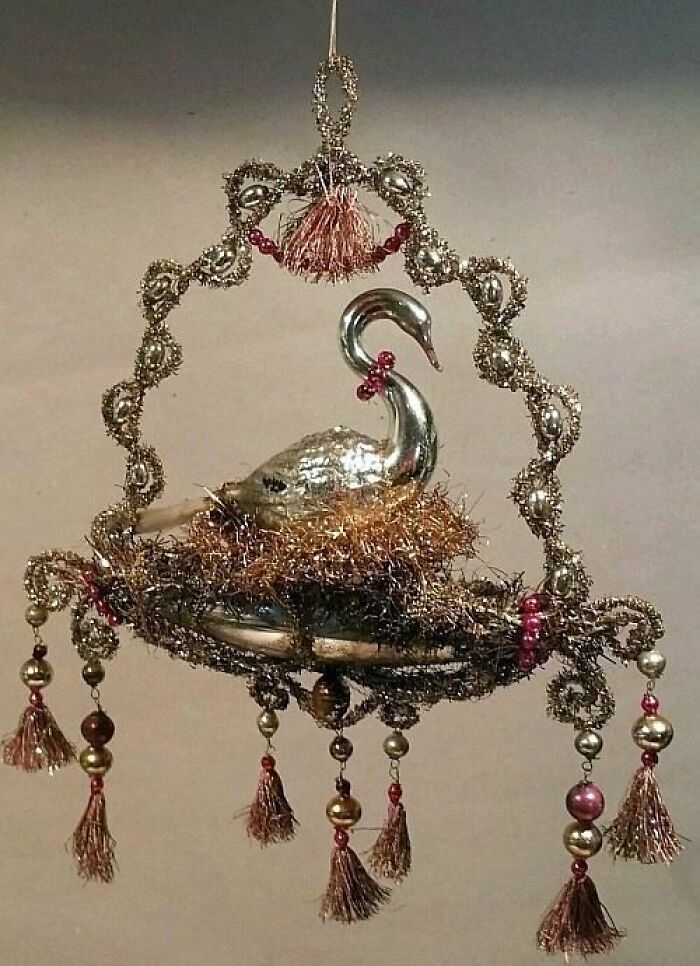
Czech Gablonz” refers to Jablonec nad Nisou, a city in the Czech Republic that is the historical center of the Bohemian glassmaking industry. The term is also used to describe Gablonz-style glass products, especially antique Christmas ornaments, beads, and imitation jewelry, which are known for their fine craftsmanship and beadwork.
The area has a long history of glass production, dating back to the 8th or 9th century. German settlers established glass factories there around 1550, and the city became a major global supplier of glass beads and other products by the 19th and 20th centuries.
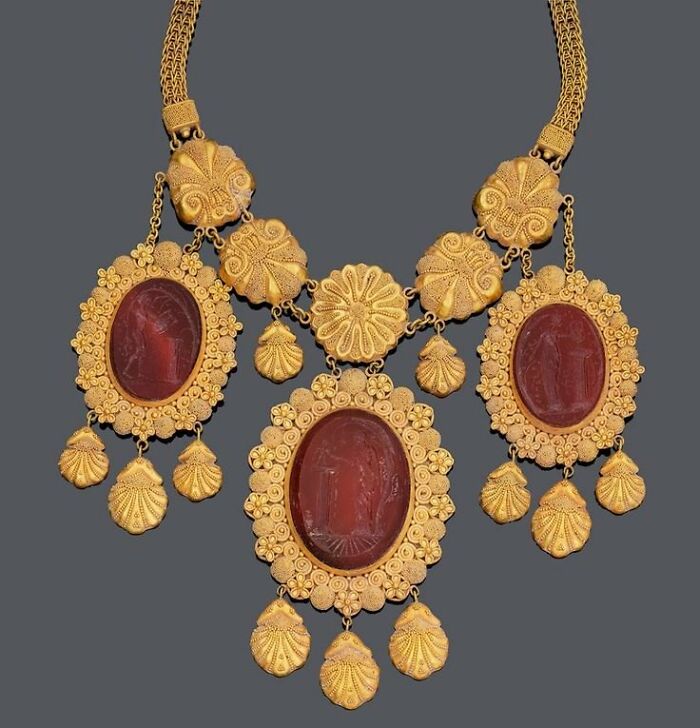
In yellow gold Double-foxtail necklace in archaeological revival style, centered by 5 finely granulated flower and palmette motifs, suspending 3 pendants, each set with 1 oval sard intaglio depicting scenes from antiquity, surrounded by flower motifs and granulated gold hemispheres and accented by shell-shaped pendants.
And let’s not forget about the drama, specifically, dramatic earrings. Long, shoulder-grazing earrings were the moment. They swayed with every step, caught the light in all the right ways, and basically said, “Look at me.” Whether they were metallic, gem-studded, or shaped like funky abstract art, they brought that extra flair everyone secretly wants.
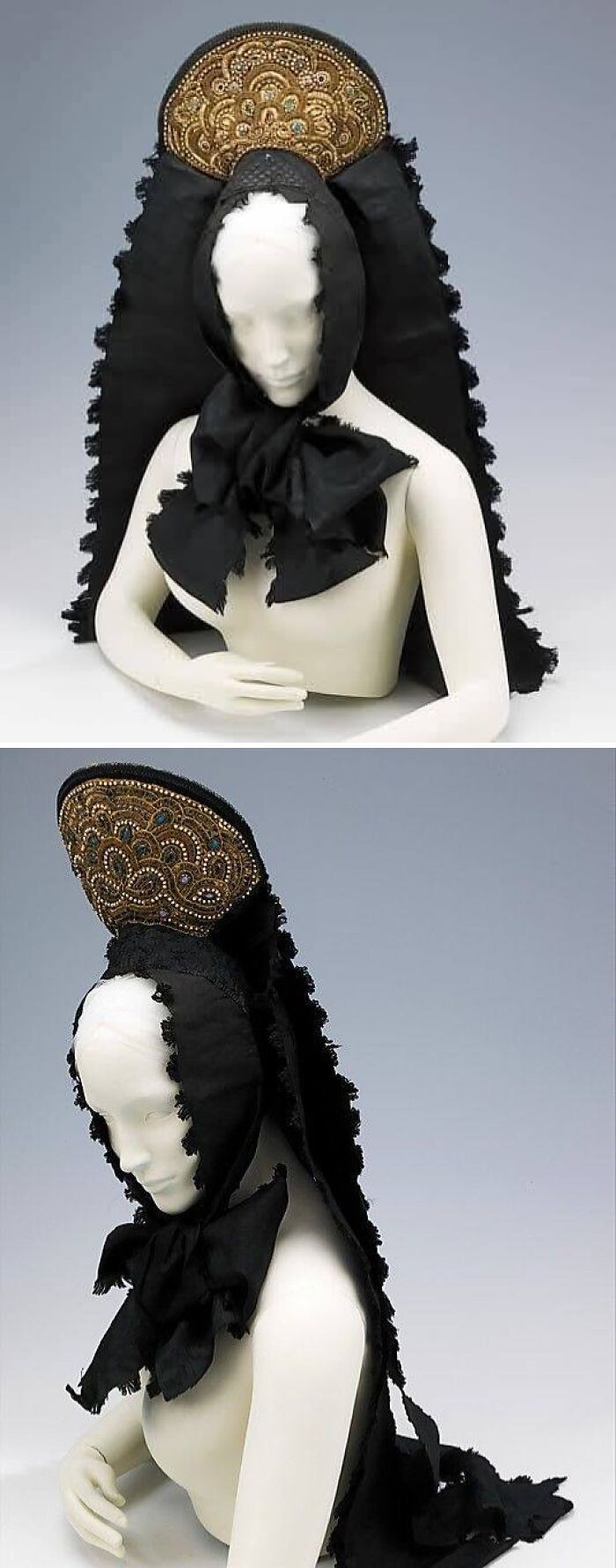
All sides of this regal headdress are equally ornamented, creating an overall dazzling effect. The abundance of gold embroidery and stones add to the grandeur and importance of this Bavarian headdress.
The style is known as a “queen’s crown” in the town of Buchloe, located in the Schwaben region of Bavaria, Germany.
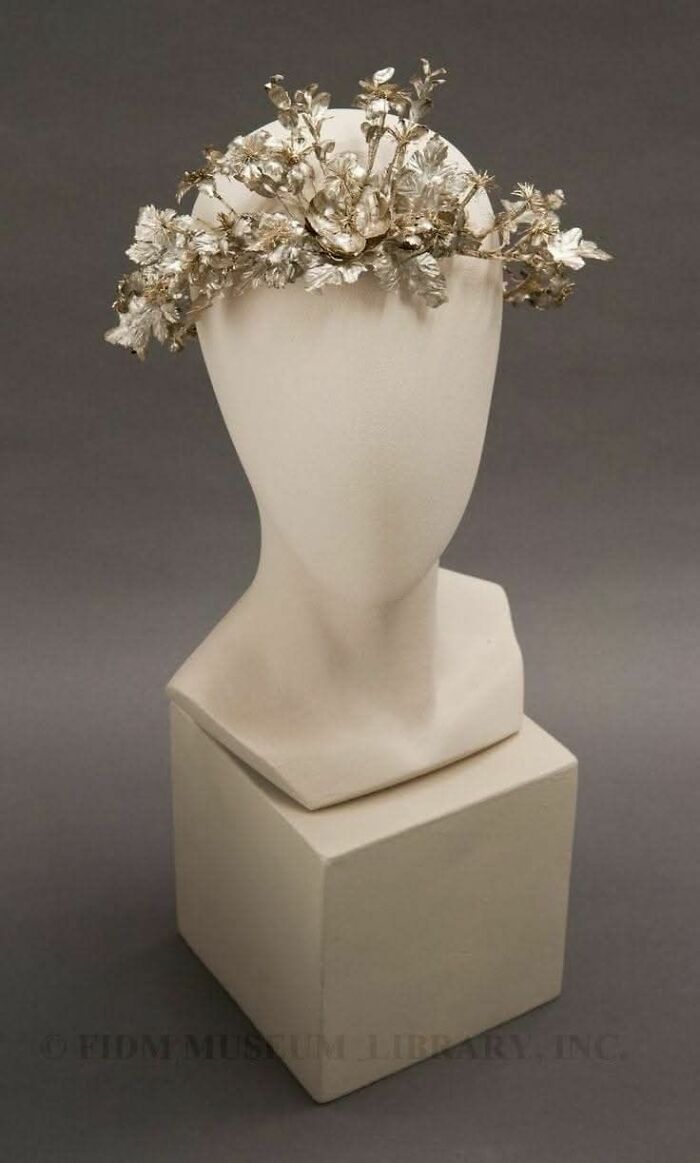
Delicate headdresses made of jewels, ribbons and real or artificial flowers and leaves were popular in the late 1850s and early 1860s. These were worn primarily for evening or formal dress, and often matched or complemented motifs seen on the dress itself. Whether incorporating roses, ribbons or the oak leaves seen here, this style is a clear reference to the crowns seen on ancient Greek and Roman statuary. In both ancient Greece and Rome, wreaths of flowers or leaves were awarded to Olympic athletes, military commanders and supreme rulers. Oak leaves and acorns have a particular significance, as they were sacred to the Greek god Zeus and his Roman equivalent, Jupiter.
Like many consumer goods of the mid-nineteenth century, headdresses could be purchased at multiple price-points. The most lavish, worn by royalty and wealthy aristocrats, incorporated precious jewels, gold and silver. More modest headdresses were made of leftover ribbon and fresh flowers. The silver paper headdress seen here was perhaps a less expensive version of the diamond headdresses worn by the upper echelons of society. Like some of its more expensive cousins, this delicate paper headdress was meant to tremble delicately when the wearer moved. Each leaf and flower is wired to the headband, so that the slightest movement creates a delicate, trembling movement akin to the wind gently brushing the leaves of a tree.
-FIDM Museum
Now enter bangle bracelets: chunky, stackable, and impossible to ignore. Some were gold, some were neon, and some were so loud they jingled like you were carrying a tambourine. People wore them by the dozen, stacked from wrist to elbow, mixing metals with colors and textures with patterns. Together with those long earrings? Pure 1960s magic.
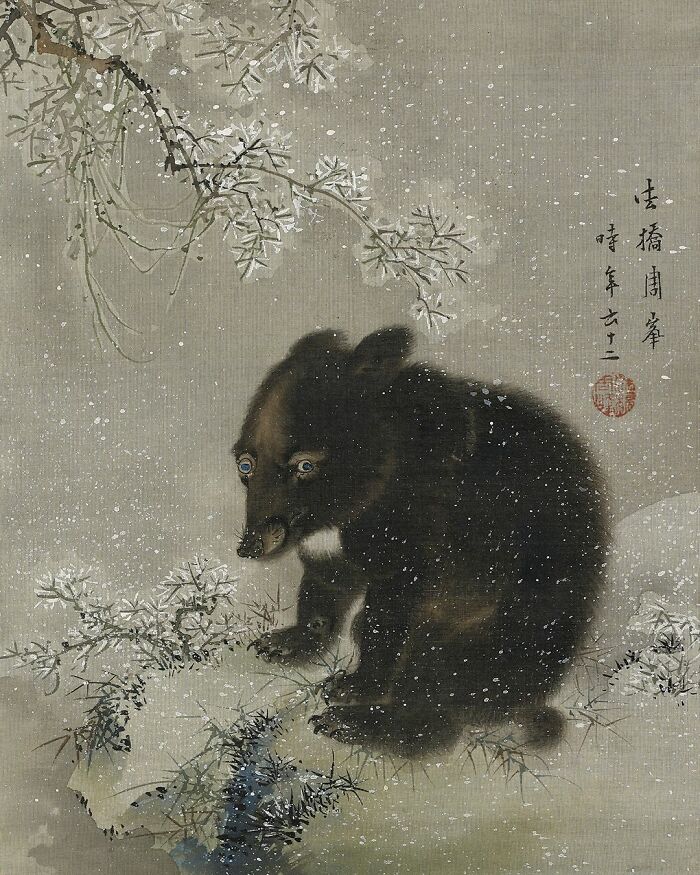
Painted by Japanese artist Mori Shūhō, this small bear looks directly out at the viewer while it sits uneasily on a ledge amid the snowflakes. Shūhō was a member of the Mori School of artists who specialised in lifelike depictions of animals.
He was the elder brother of Sosen (1747–1821), the famous painter of monkeys. Though less well regarded than his brother, Shūhō was a respected and prolific artist in his hometown of Osaka.
Shūhō often wrote his age after his signature, as done here, making it possible to chart his career quite closely. He painted this work when he was sixty-two.
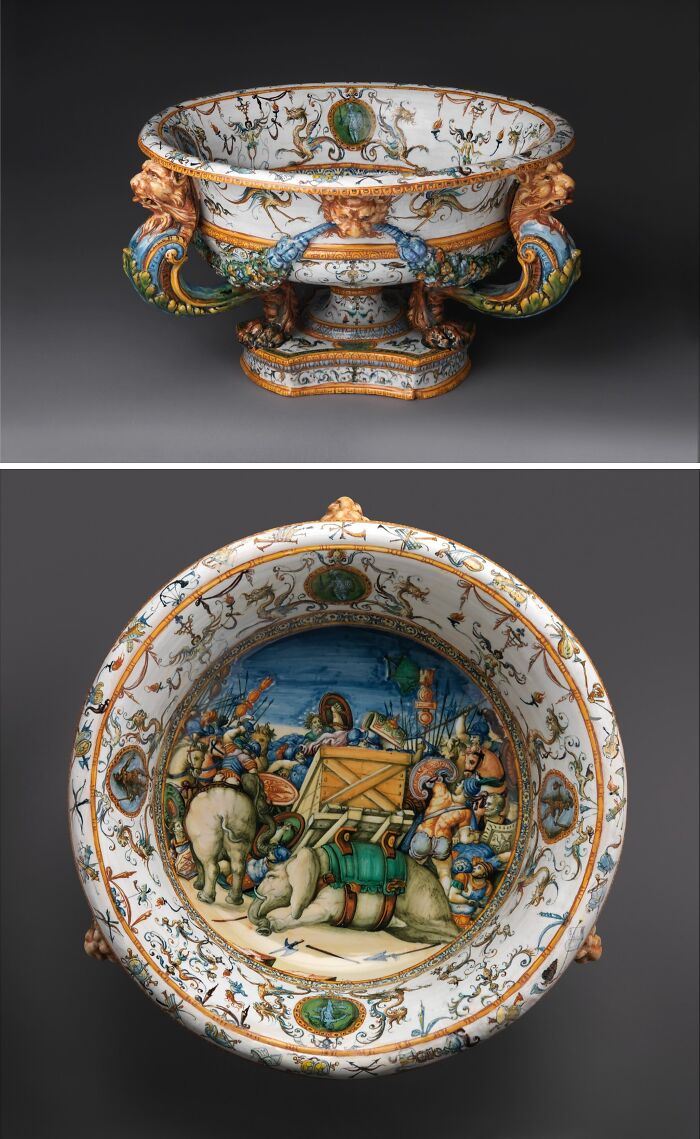
Coolers were set near the table on a credenza or sideboard, visible to diners and within easy reach of servants. They are designed to be viewed from any side, but especially from above when empty. When not in use, coolers remained in place to convey the owner’s refined taste and, due to the relatively inexpensive medium, personal modesty.
Honestly, the 1960s feels like a jewelry fever dream, in the best way. Everything was bigger, bolder, and bursting with personality. You could be elegant one day and eccentric the next, all with a change of earrings. It was a time when fashion didn’t whisper, it shouted.
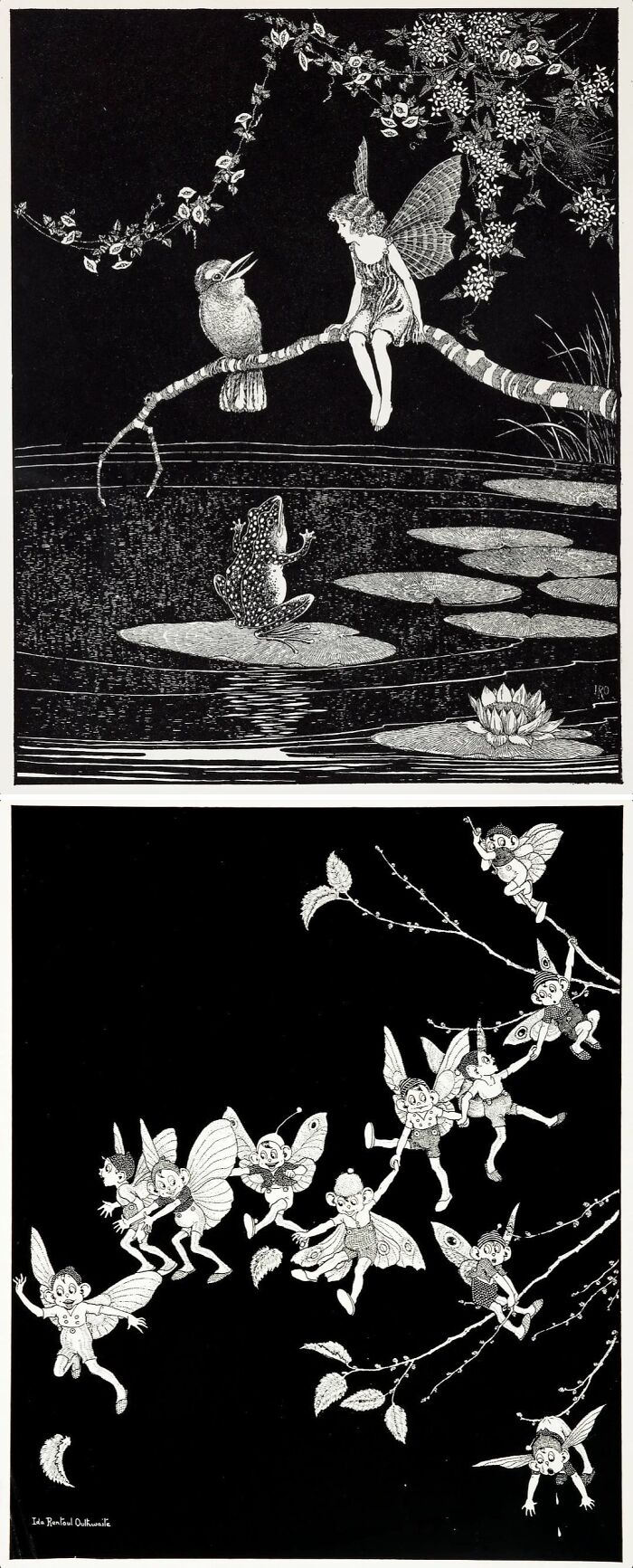
Outhwaite worked predominantly with pen and ink, and watercolour. Her first illustration was published by New Idea magazine in 1903 when she was just 15 years of age – it accompanied a story written by her older sister, Annie Rattray Rentoul. In the years that followed, the sisters collaborated on a number of stories.
Following her marriage, she also collaborated with her husband – most notably for The Enchanted Forest (1921), The Little Fairy Sister (1923) and Fairyland (1926). In a number of cases, her children – Robert, Anne, Wendy and William – served as models for her illustrations.This was the period during which she did her best work, particularly Elves and Fairies (1916), a glorious art book with color plates as well as black-and-white.
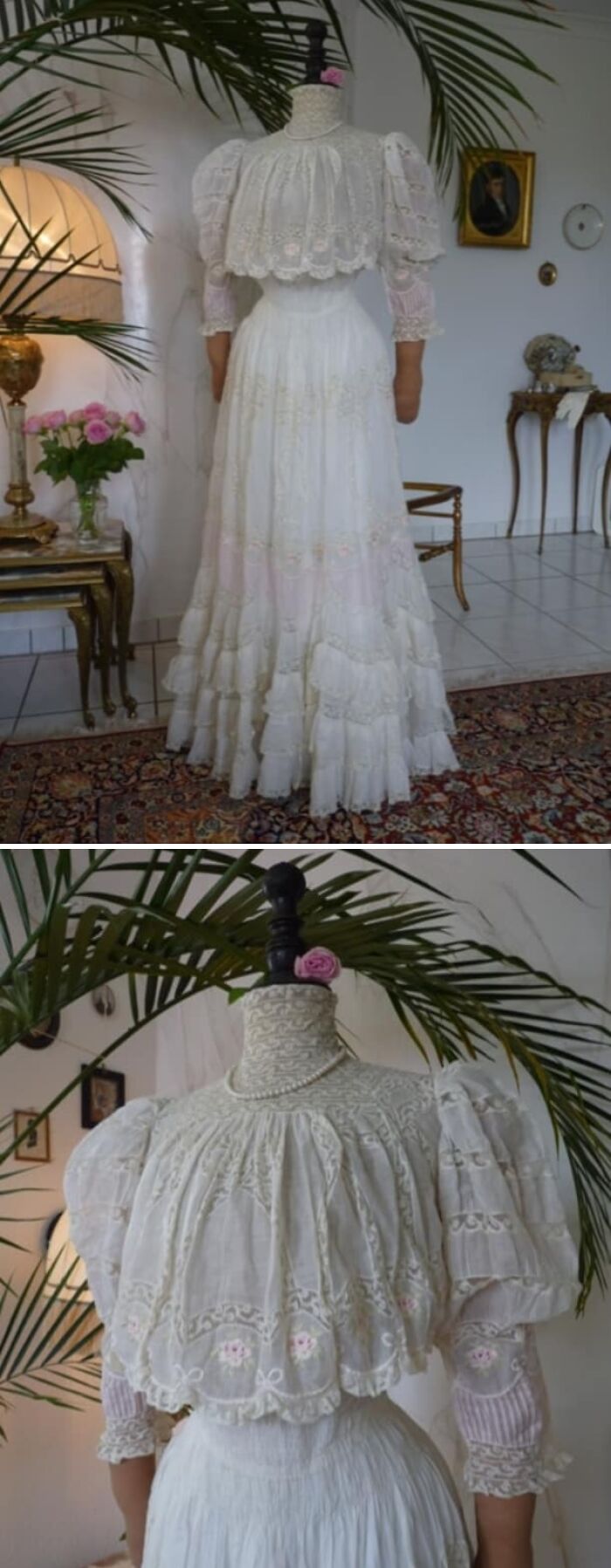
High neck and bands in a pattern of loops and bows. Decorated with a band of polychrome embroidered roses at lower bodice, sleeves and skirt. Sleeves and skirt have scalloped inserts of tucked pink cotton beneath embroidered bows. The lower skirt is ruffled in three bands.
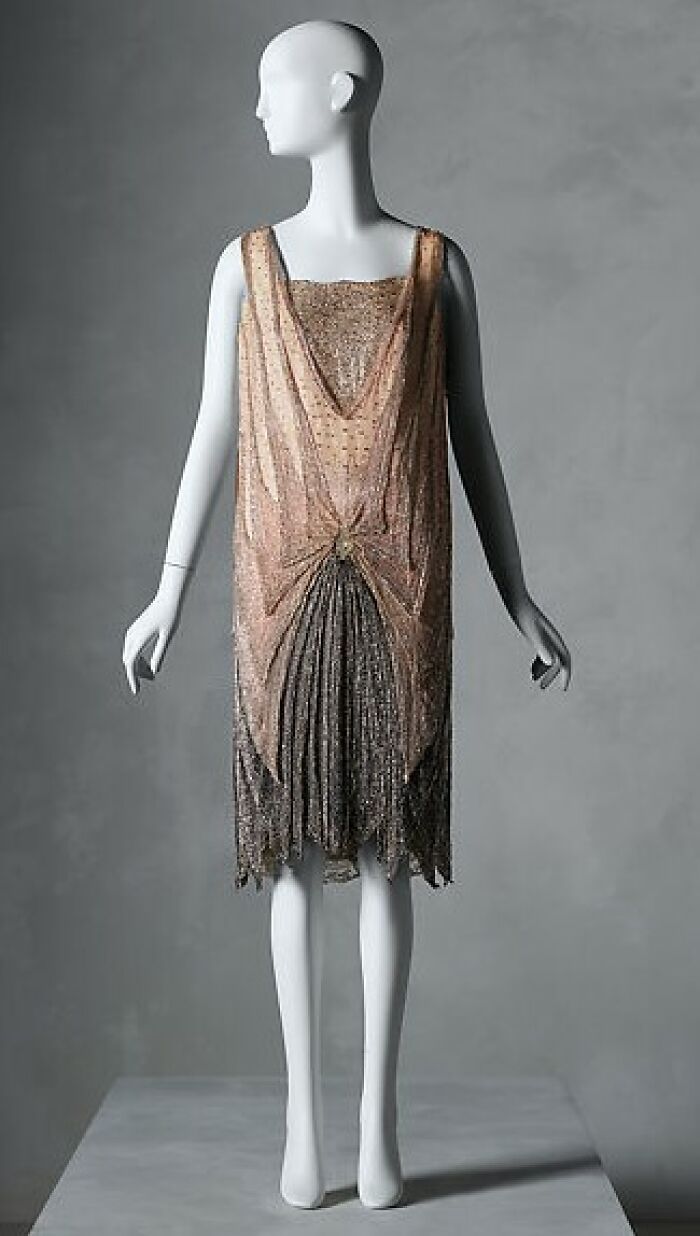
Each of the lightweight chiffon tiers has been weighted with a glittering constellation of beads. The embroidery extends beyond the overlap of every layer to convey the impression of continuous embellishment.
With all the layering and beadwork, this gown would have been amazing to see when worn and the lady moves about.
And what’s amazing is that it wasn’t just about the jewelry, it was a whole vibe. These posts show every detail from back then had flavor. So tell us, which photo made your jaw drop? Let us know your favorites in the comments, we’re excited to see what you’d bring back.
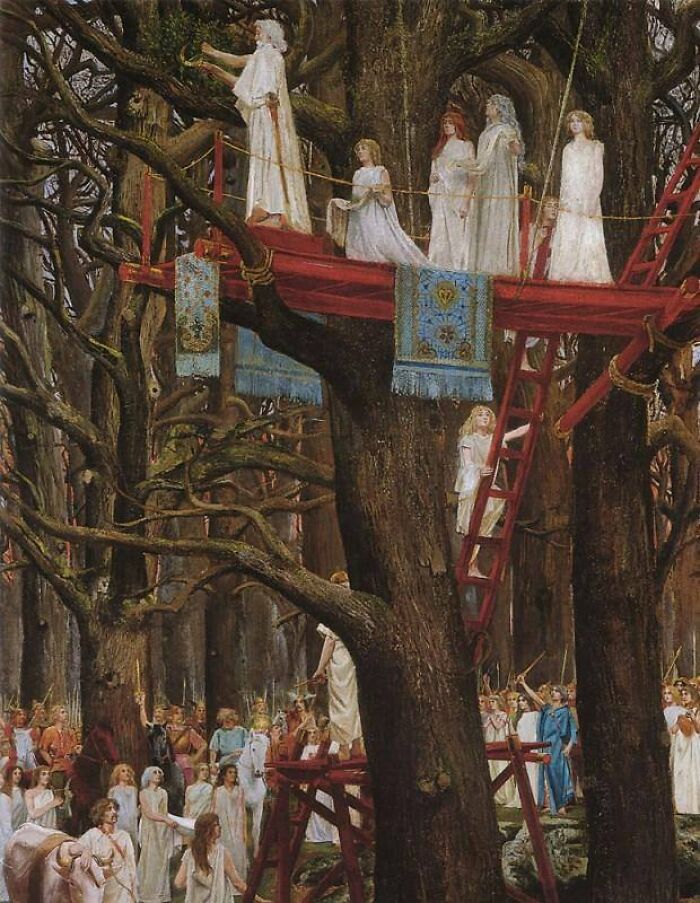
It depicts a Celtic religious ceremony based on a description by the Roman author Pliny the Elder.
The ritual involved white-clad druids climbing a sacred oak tree and cutting mistletoe with a golden sickle. The mistletoe was believed to have medicinal properties and was used to make an elixir to cure infertility and poison effects.
Henri-Paul Motte (1846-1922) was a French painter from Paris who specialised in historical subjects. A pupil of French painter Jean-Léon Gérôme, whose works likewise included historical paintings as well as Greek mythology and Orientalism. Motte first exhibited his paintings at the Paris Salon of 1874.
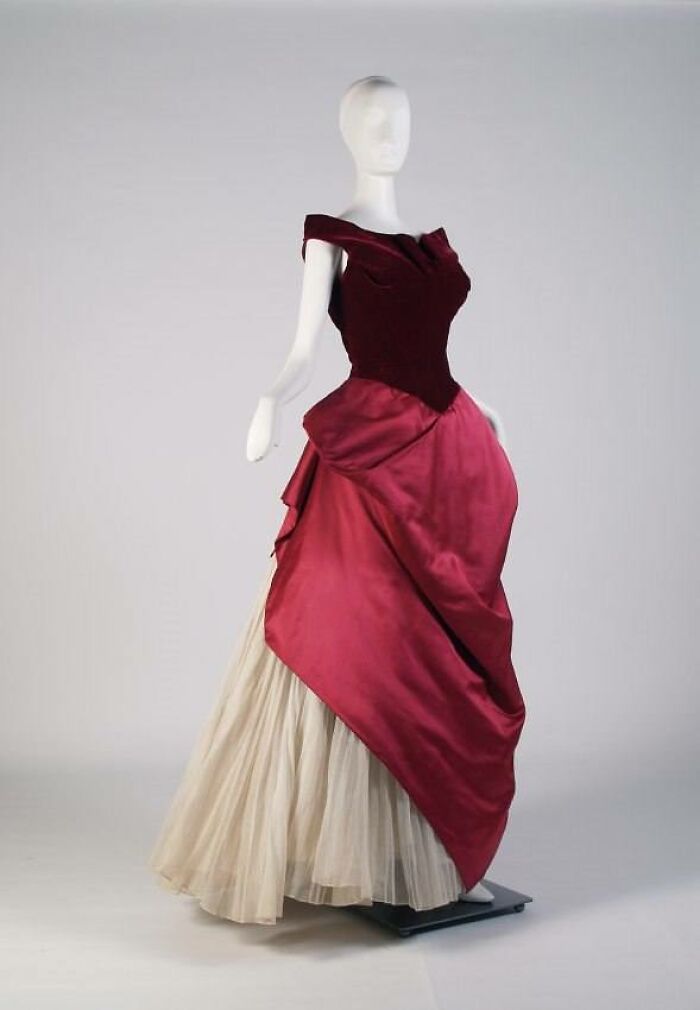
Ruby red silk velvet, garnet Catoir silk satin, white organdy. Draped, fitted & boned bodice of velvet, asymmetrical satin polonaise drape, pleated silk organdy underskirt. Silk faille facings.
-KSU Museum
The Catoir Silk Company was an American textile company founded in New York in 1889 and operated until it closed in 1989. The company had a major silk mill in Allentown, Pennsylvania, which was part of the region’s larger silk industry. The mill’s closure in 1989 marked the end of its century-long history.
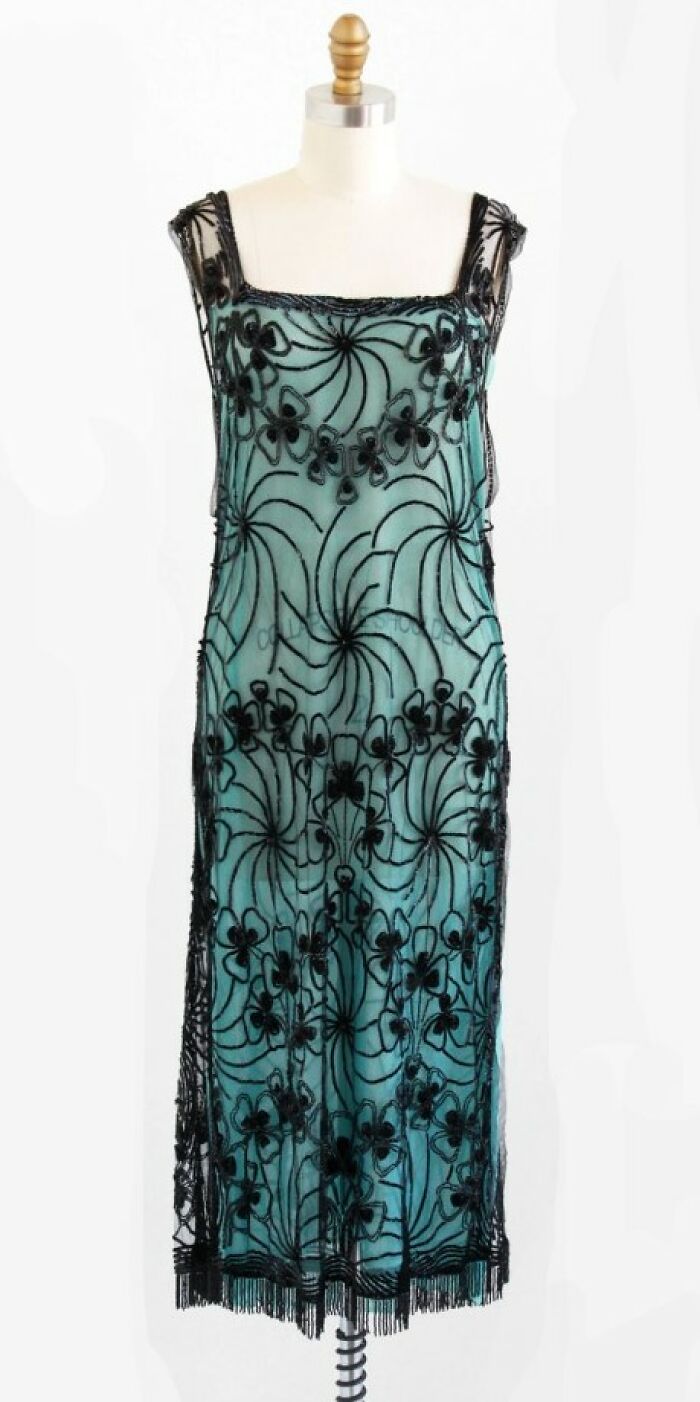
This is an over dress and is missing the underdress, which was probably the same color of the minty aqua lining.
It’s a bit hard to see but the back sequin part is all one piece. It’s then been attached to the colored lining.
It is possible that the sheer black over-dress was sold alone with no under dress at all. The lady bought the black over dress and then decided to have it worn with a minty aqua underdress.
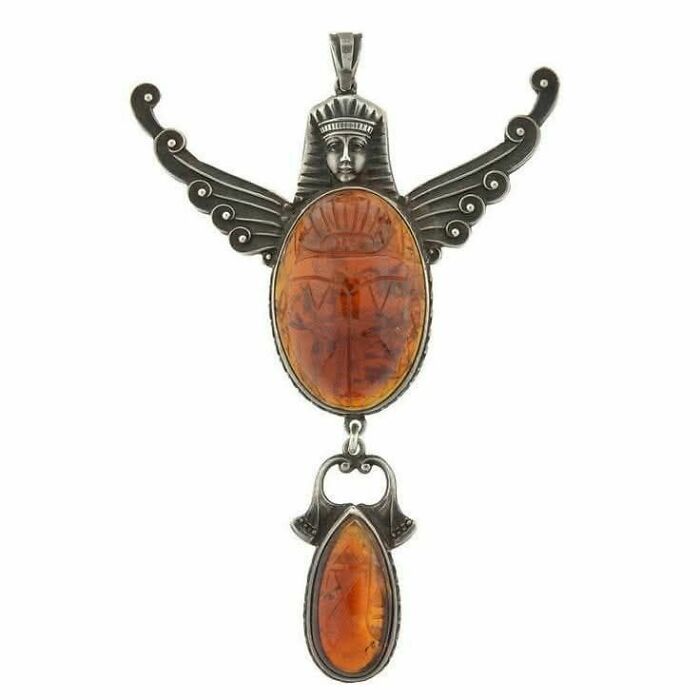
During the 19th century, the discoveries of ancient archaeological finds influenced and brought on what is referred to as “archaeological revival jewelry,” or “Egyptian revival jewelry.” The initial Egyptian Revival period flourished from the 1820s and was inspired by ancient Egyptian imagery, such as the scarab beetle, sphinxes, pharaohs, and hieroglyphics.
This piece is made of sterling silver with a dramatic Pharaoh and scarab design. The top of the pendant depicts a large hand-carved amber scarab at the center, which is bezel set in an ornate sterling mounting. Outstretched wings with swirled detail rest at either side, and at the top is the head of an Egyptian Pharaoh wearing a traditional headdress. Dangling freely below is a teardrop amber cabochon in a decorative sterling bezel, which has carved hieroglyphic symbols carved into the surface.
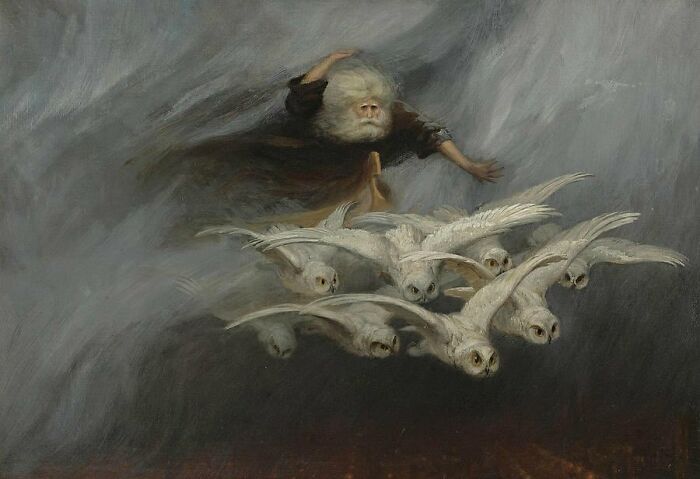
William Holbrook Beard (1824-1900) was known for his satirical and whimsical approach to painting, often depicting animals with human characteristics. Born in Painesville, Ohio, Beard began his artistic career as a portrait painter, later shifting his focus to animal subjects.
The painting features an old man with a long white beard, symbolizing winter, flying amidst a flock of white owls. The work is part of a series of four paintings representing the different seasons.
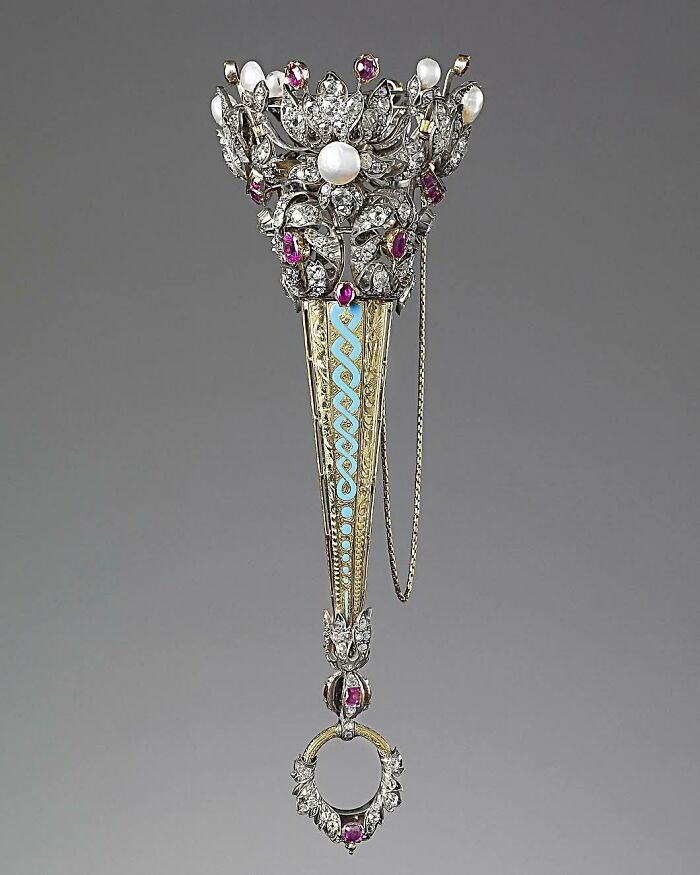
This specific piece was a gift to Queen Victoria from the French Empress Eugénie during a state visit to France in August 1855.
The holder is elaborately decorated with diamonds, rubies, and pearls. It features intricate gold and silver openwork, with a central section adorned with light blue enamel in a Celtic knot pattern.
-Royal Collection Trust
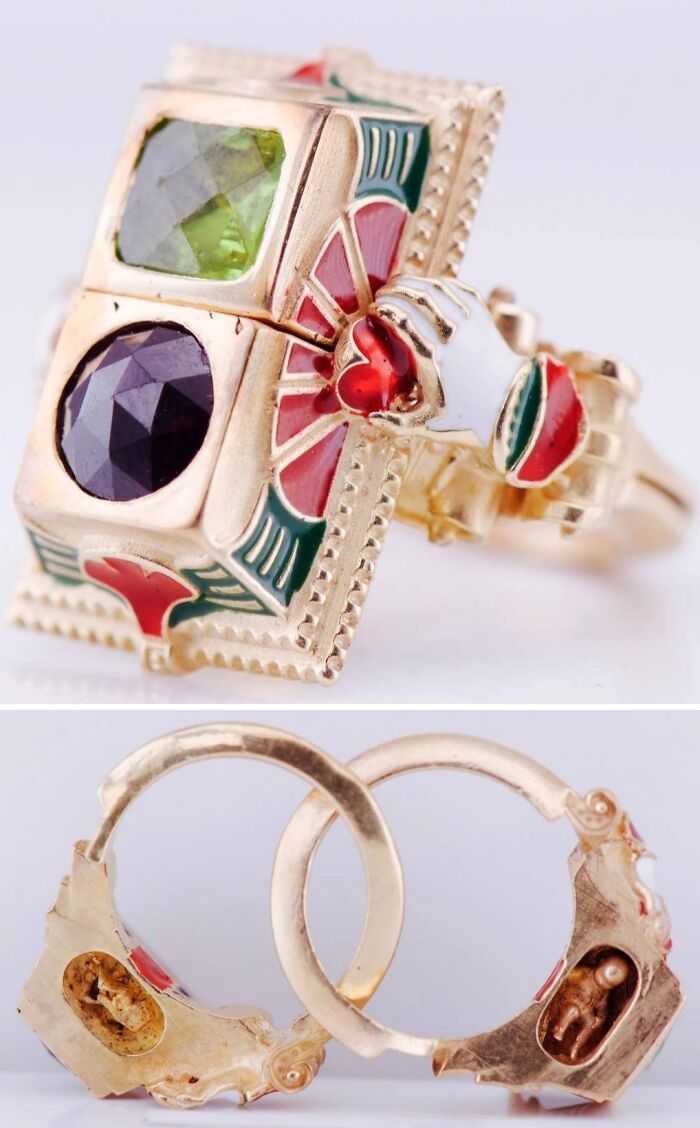
The ring is decorated with natural Demantoid and Garnet precious stones set in 18k solid gold. The rings open, splitting the band in two to reveal hidden tombs with two skeletons inside and an engraving in Latin” Vanitas Vanitatum Et Omnia Vanitas”.
“Vanitas vanitatum et omnia vanitas” is a Latin phrase that is translated to “Vanity of vanities; all is vanity.” The phrase is taken from the Book of Ecclesiastes in the Bible, where it is used to describe the transience and futility of worldly pursuits and possessions.
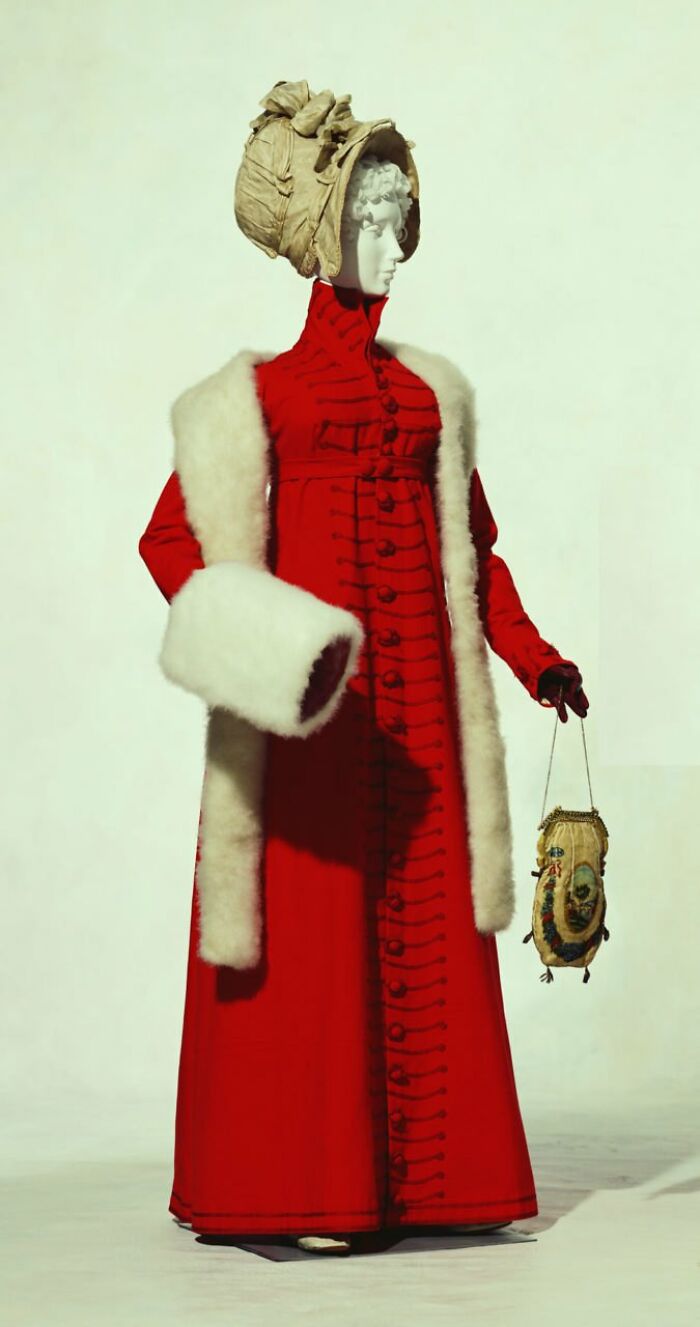
Red wool flannel “redingote” with braid and wrapped buttons in Brandenburg style; bag of beige velvet, hand-painted with floral and scenic motif, chain strap; muff and palatine of swans-down.
A military style, “redingote”. The full-length, wool coat protected women wearing thin, muslin dresses from the intense cold of European winters. The Brandenburg style, expressed in the wrapped buttons and braid that decorate the front opening, gained inspiration from the “à la Hussarde” worn by Napoleon’s armed forces, and was often used on the high-waisted redingote. The coat worn for horseback-riding by English aristocrats came to be used as a cold proof overcoat and a rain-proof hunting coat in France around 1725. Later, this kind of coat was used by the army as well. What was called a “riding coat” in English became in French a “redingote”, and was an item worn widely around the end of the eighteenth century. At the time women’s clothing was strongly influenced by the functional and practical style of men’s and military wear.
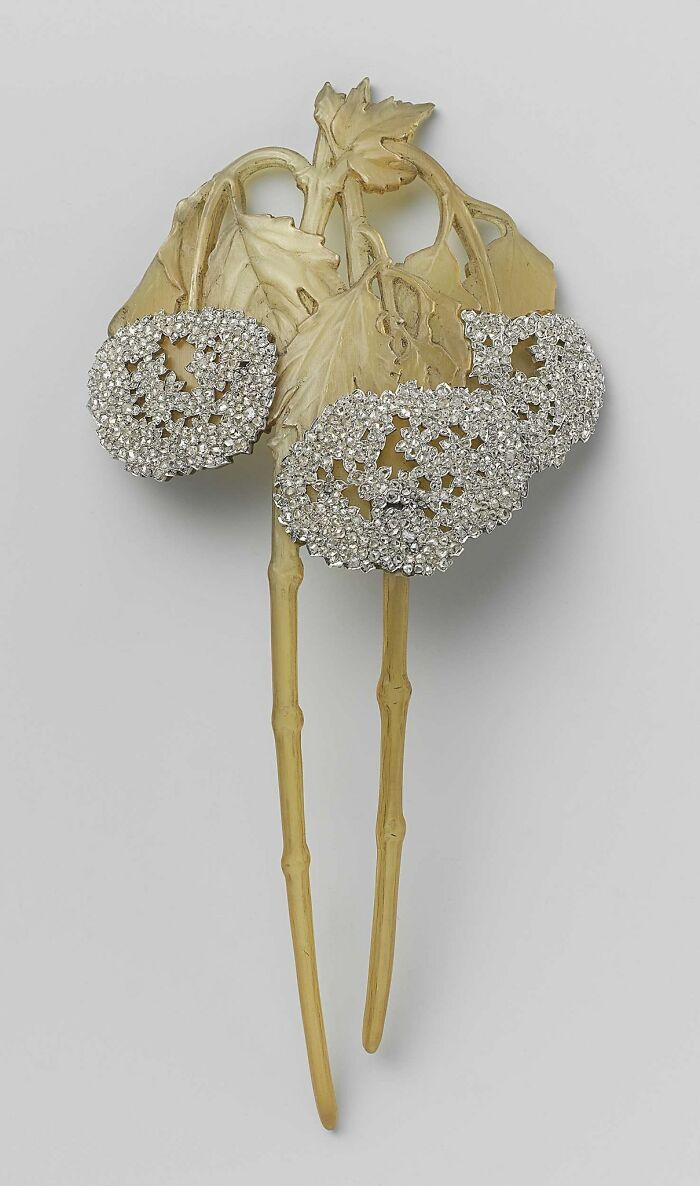
Hair comb of horn, gold and diamonds. The crest is inspired by Japanese models and is shaped like two branches of a shrub with flowers (Viburnum opulus roseum ‘snowball’).
-Haarkam in de vorm van twee takken Viburnum – Rijksmuseum, Netherlands
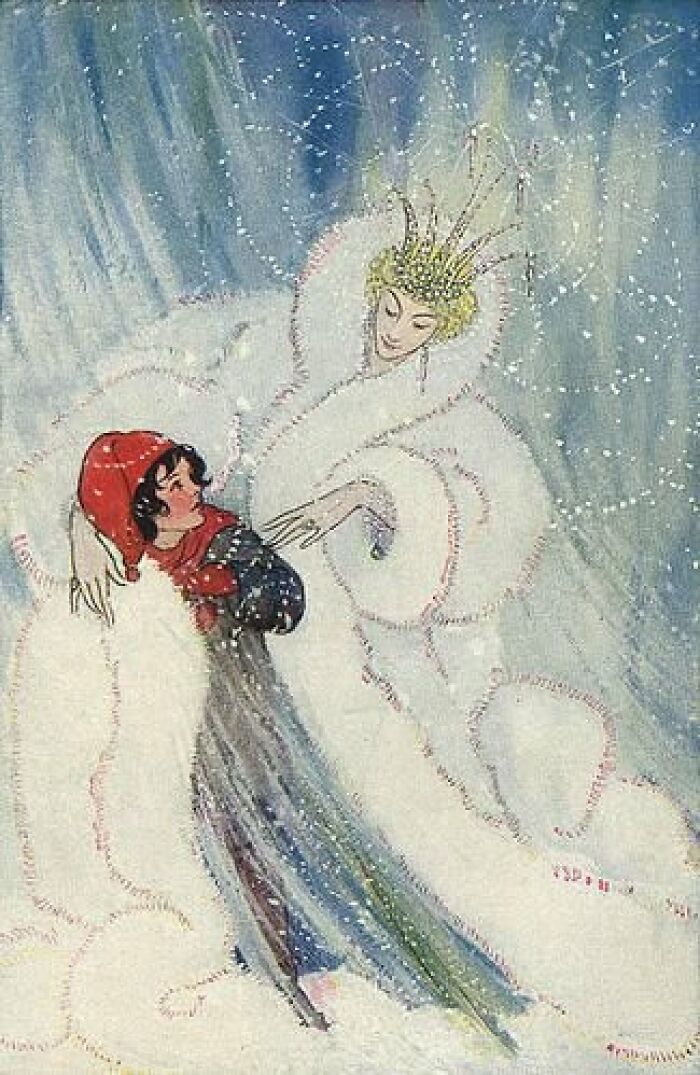
Watercolor, gouache, pen, and ink on paper.
“Many a Winter’s night she flies through the streets and peeps in at the windows and then the ice freezes on the panes into wonderful patterns like flowers”.
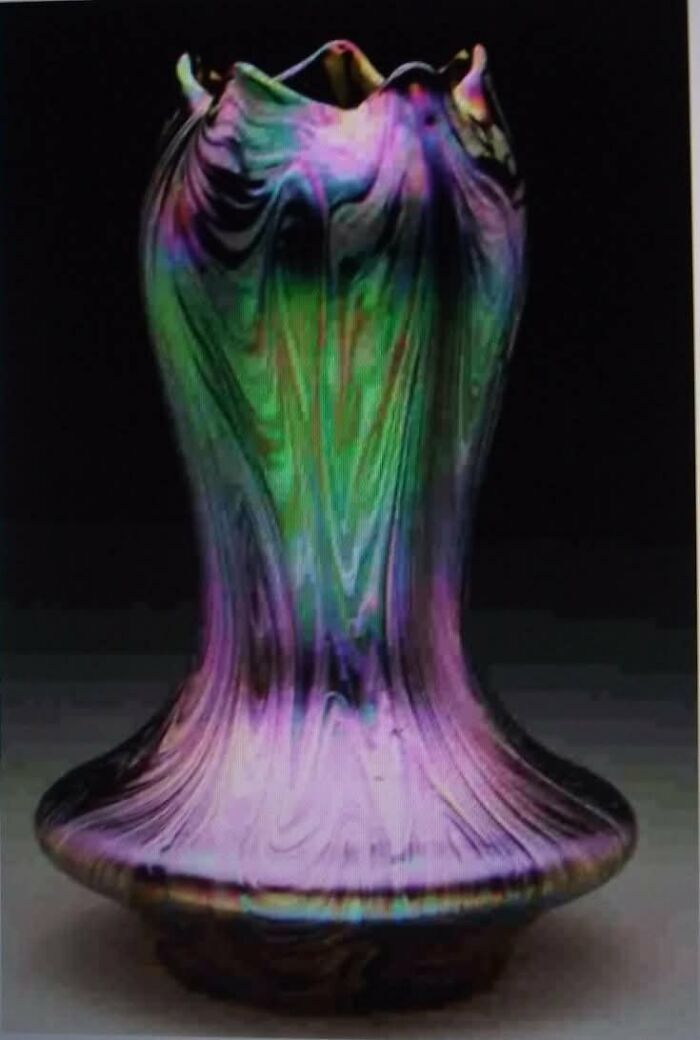
A cream and purple dragged loop design descending from the lip and rising from the foot, encircling the entire vase, finished with a ruffled lip.
Rindskopf glass was produced by a company called Josef Rindskopf’s Sohne AG, which translates from German to English as Josef Rindskopf’s Sons. This glass manufacturer was set up by the sons of Josef Rindskopf after his death in 1890, and was located near the spa town of Teplice in what is now the Czech Republic
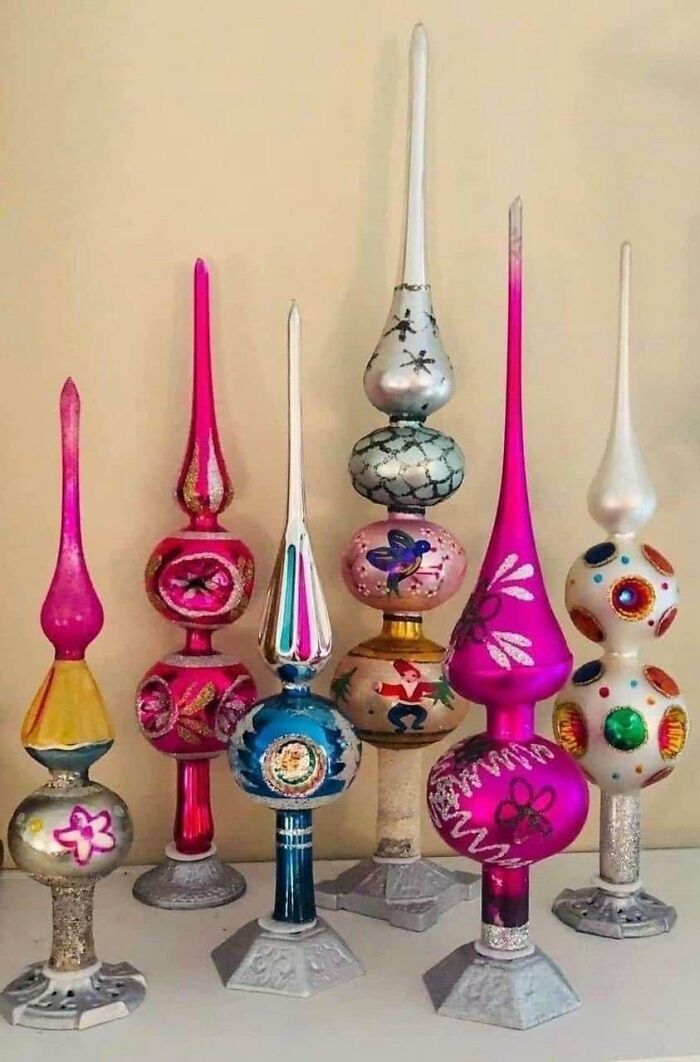
They hark back to a classic style popular in the mid-20th century. The ornaments are made from glass and feature various colors and decorative patterns.
The style, featuring a spindle or ball and spire shape, is a traditional European design, with glass ornaments tracing their origins to Lauscha in 1847. These fragile items are often passed down as heirlooms through generations.
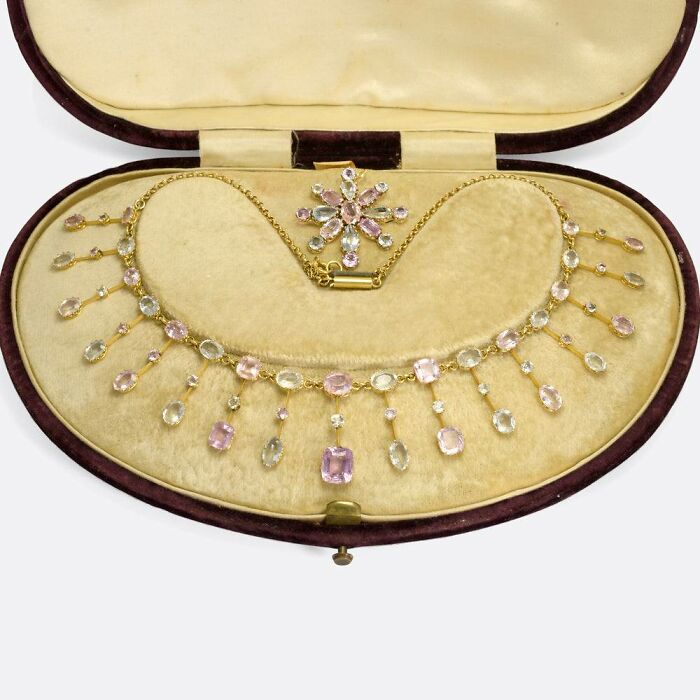
In 15k gold, and set with the Imperial (or “precious”) pink, and sky blue gems color.
The box indicates that they were retailed by Mallett Goldsmith, Bath – now known as Mallett Antiques, with galleries in London and New York who regularly exhibit at the International Fine Art & Antique Fairs.
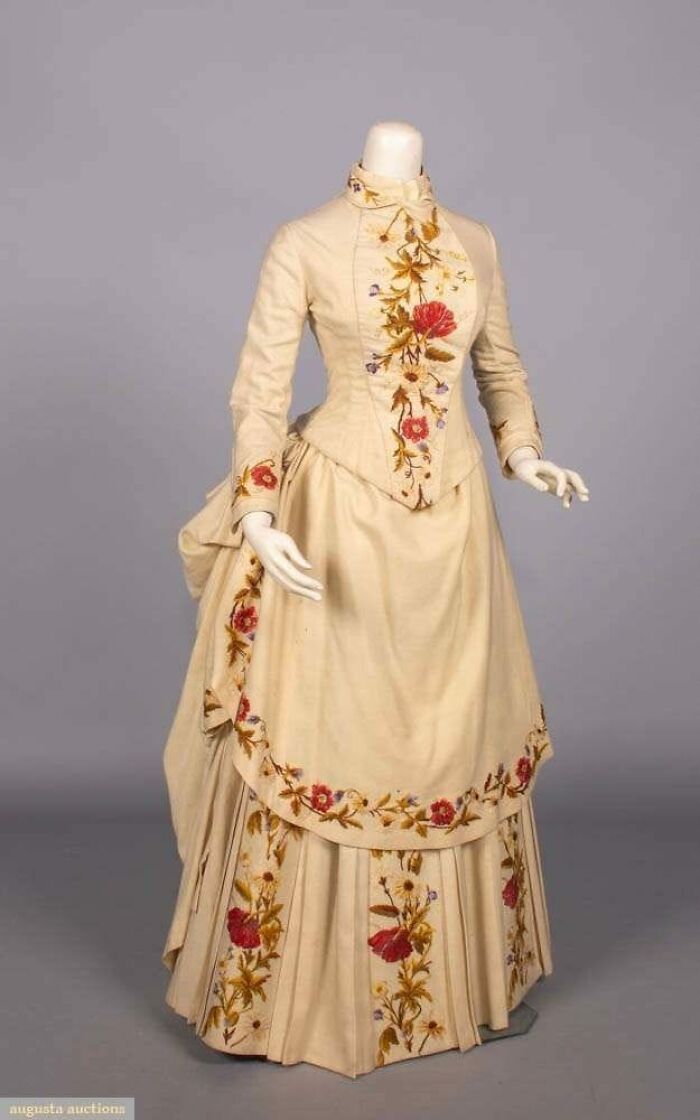
2-pc cream twill wool flannel day dress hand embroidered with satin stitch floral motifs in wool & silk to convertible collar, center front & back of fitted bodice, cuffs, front of integrated apron overskirt & in vertical bands at skirt front, bodice. -Augusta Auctions
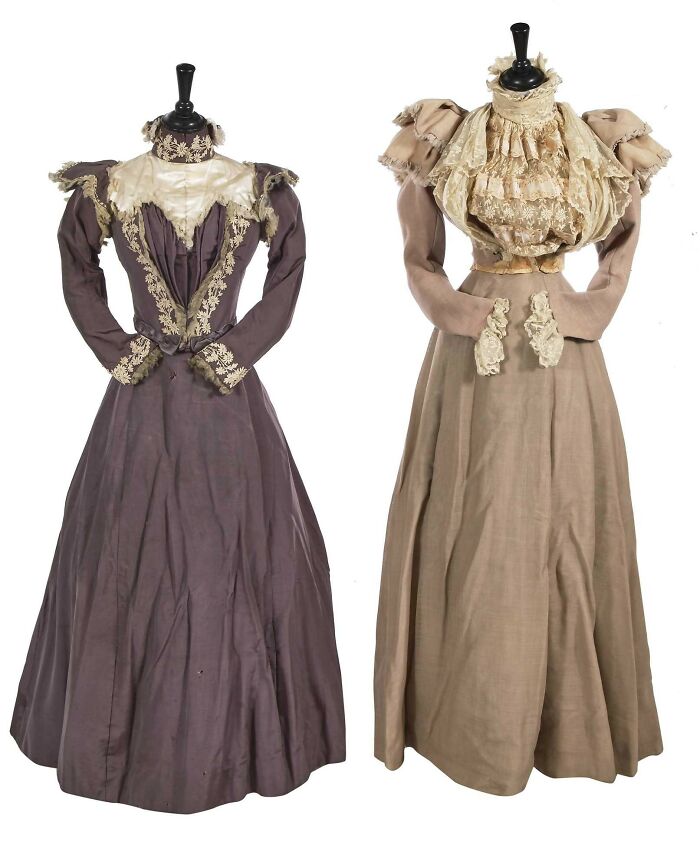
The first by Wallis & Co of Paisley, of grey twill silk, with high collar, appliqued chemical lace daisy bands, small flounces to the shoulders over slim sleeves, the satin yoke trimmed with chiffon and rhinestones.
The other Annie Grant of Portman Square of grey-pink gauze with high collar, silk and lace insertion to front, sleeves with double epaulettes, matching skirt.
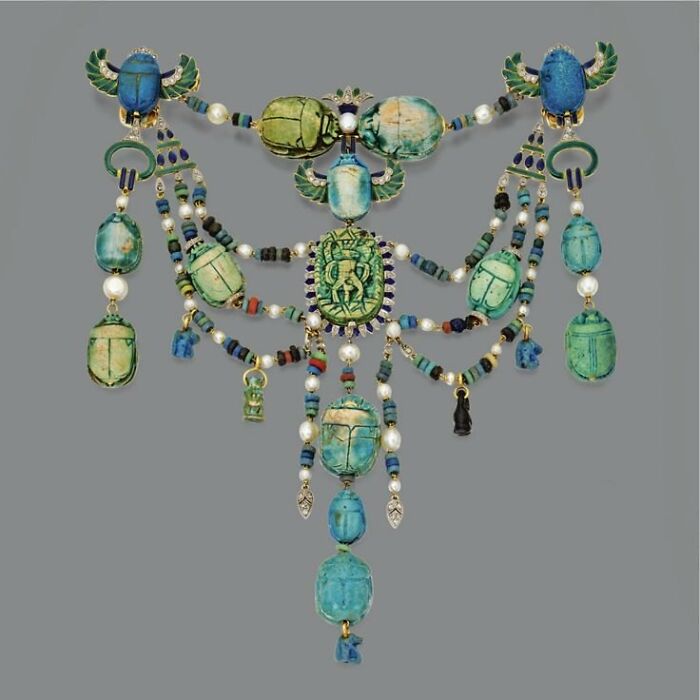
Composed of Egyptian glazed steatite and faience scarabs, amulets and beads, New Kingdom, 1554-1080 B.C., arranged in swags and fringes, further strung with pearls. The central scarab depicting the god Bes on obverse and reverse, the balance engraved on the back with hieroglyphs, three scarabs flanked by wings of turquoise and royal blue guilloché enamel, further decorated with fancy-shaped links and a lotus blossom similarly enameled, accented throughout with rose-cut diamonds, mounted in gold and platinum.
A corsage ornament is a large, ornate piece of antique jewelry, often a brooch, designed to be worn on the bodice (the “corsage”) of a formal gown, featuring elaborate floral designs or symbolic figures in precious metals and gems like diamonds, pearls, and enamel
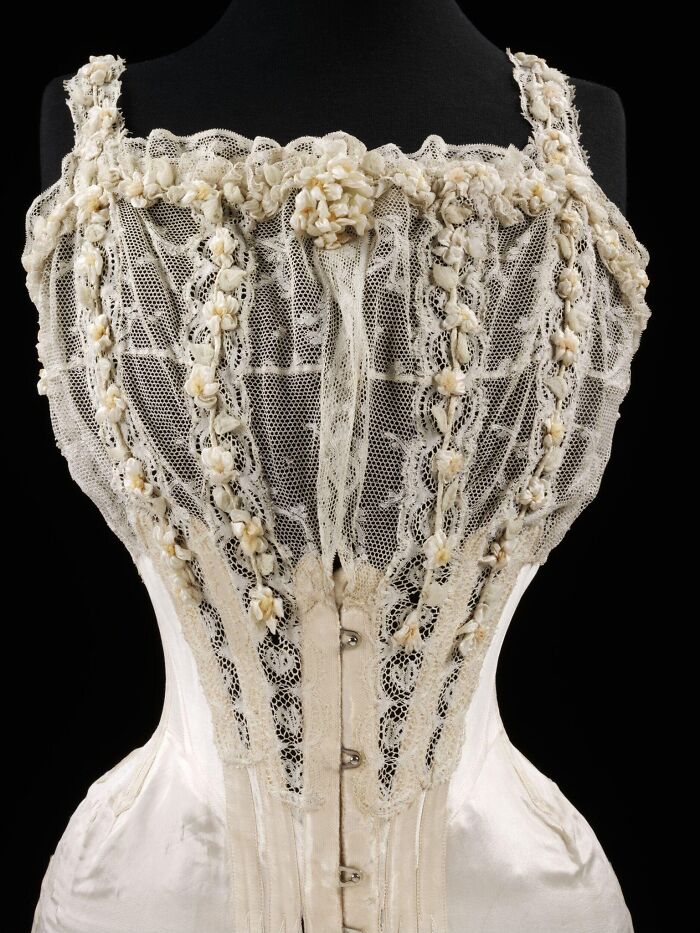
It is an S-bend corset, typified by the straight busk that compelled the pelvis backwards and the bust forwards into an angled ‘S’ shape. The corset offered some light control around the lower abdomen with strategically placed whalebones; however, since corsets rely on boning and strong fabrics for rigidity, the insertion of Mechlin-style machine lace and fine silk satin between the bones show that its function is largely decorative. The neckline is high, and the entire bust area is made of transparent lace decorated with silk flowers. At the bottom of the corset are four long suspender ribbons, attached with small gathered silk rosettes.
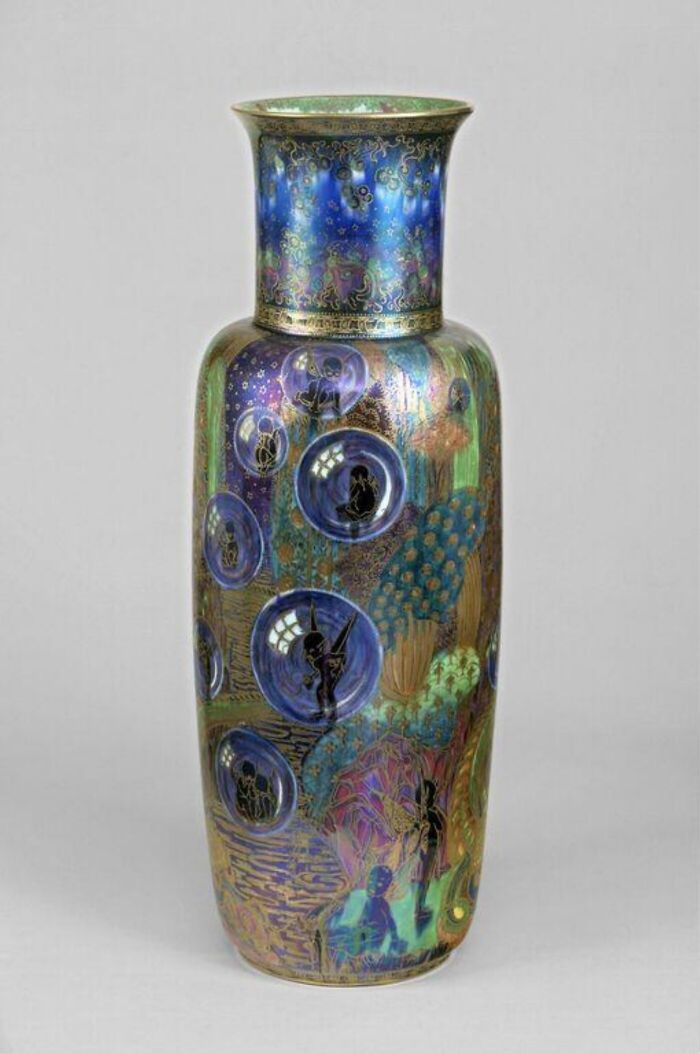
Vase decorated with the ‘Bubbles’ pattern, featuring luminous blue bubbles carrying fairyland figures towards the earth. A winged babe sits on a small grassy ledge, and a dragon can be seen coiling a tentacle around its foot. The scene is set against lush foliage and a starry purple-blue sky.
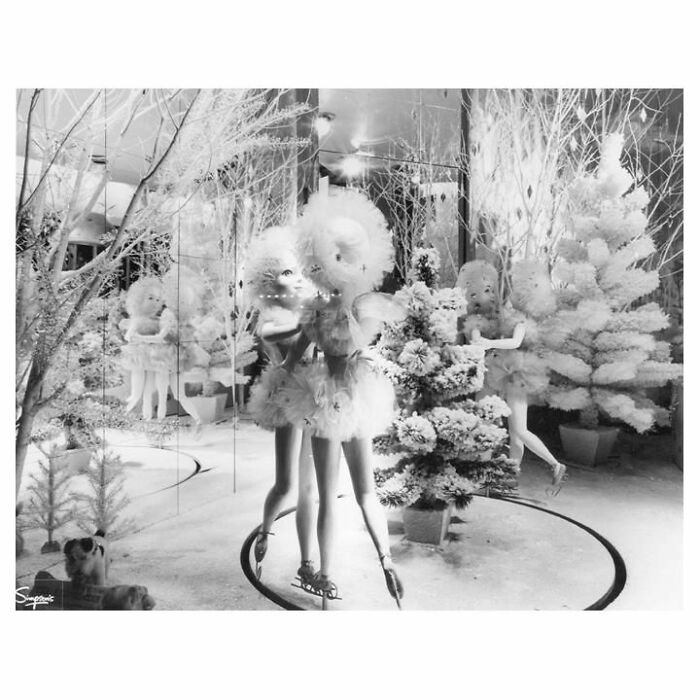
Hudson’s Bay (HBC)’s Christmas windows, especially at the iconic Toronto flagship store, were a cherished holiday tradition featuring elaborate, animated scenes of Santa, workshops, and festive stories, but this beloved custom was paused in 2023 due to construction for the Ontario Line project and remains suspended, though displays might return in different forms as HBC evolves, with past rivalries with Simpsons’ windows making them a historic part of Toronto’s retail landscape.
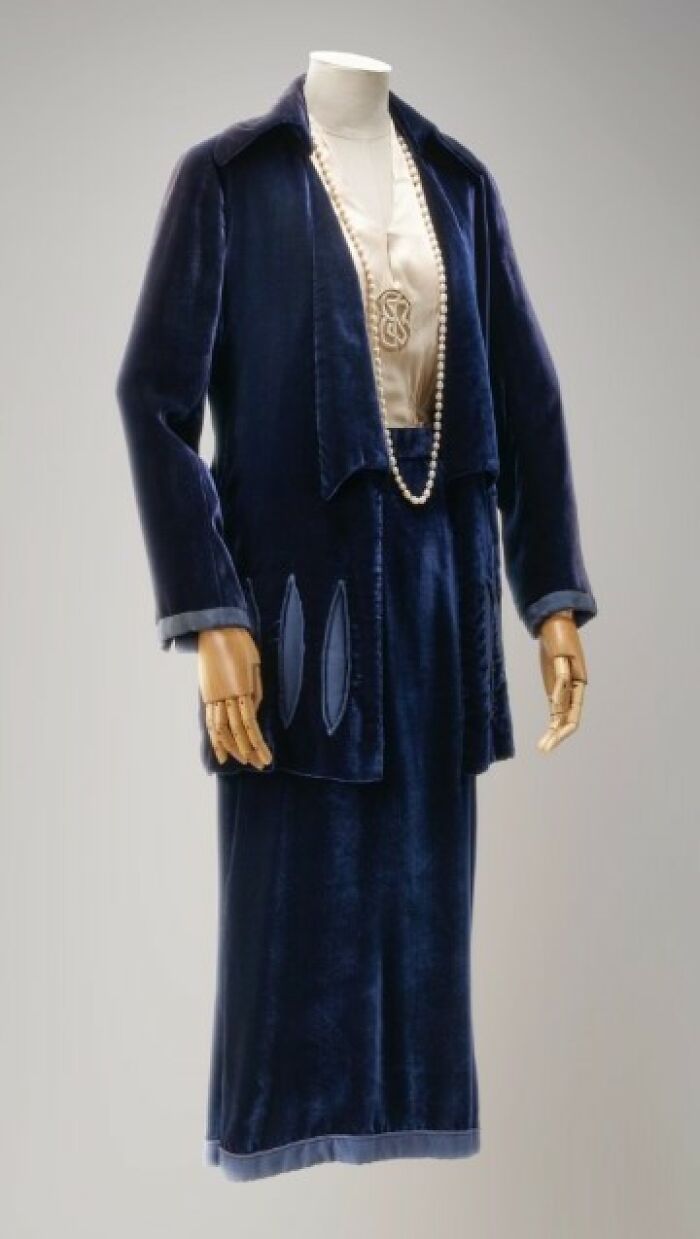
Made of blue velvet, the suit reflects the changing fashion of the time. The skirt stops low on the calf instead of to the ground. The jacket does not rely on a corset for it’s shaping.
A lighter blue is used for the trim and the reverse cut-outs of the jacket.
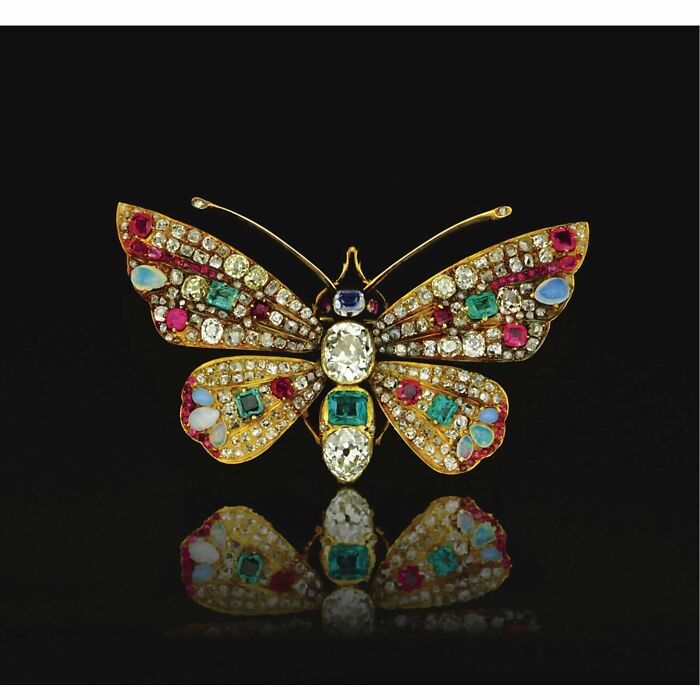
Designed as a butterfly, the head and thorax set with a step-cut sapphire and an emerald and oval and pear-shaped diamonds, the wings set with variously shaped rubies, opals, emeralds and diamonds.
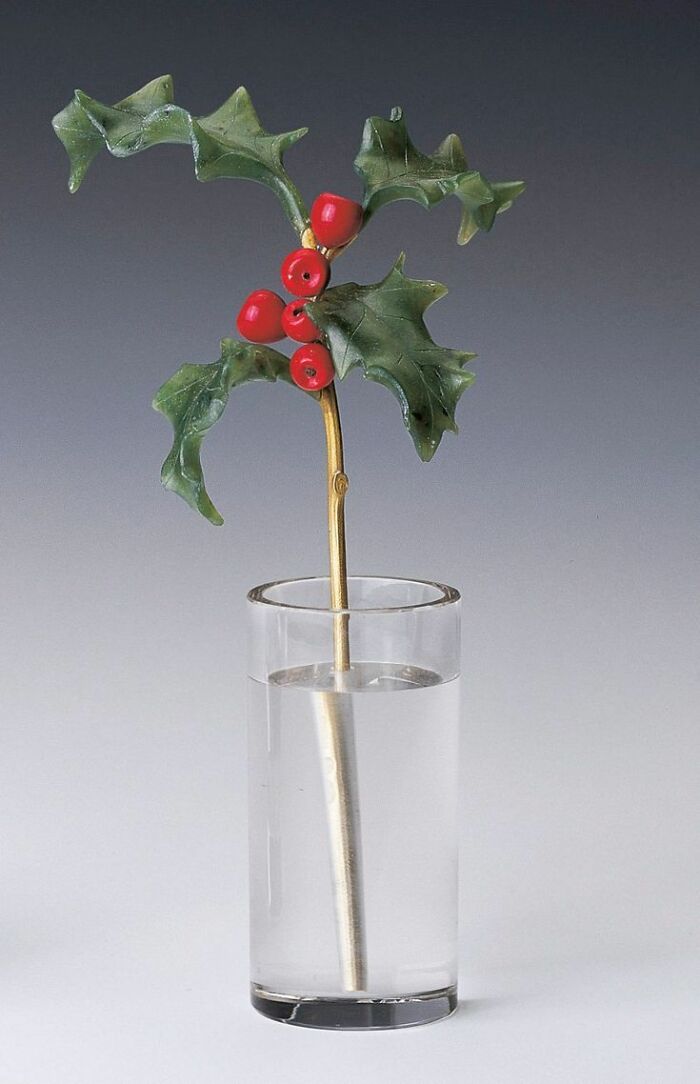
A holly sprig with five berries carved in purpurine, four leaves of highly polished dark nephrite, all attached to a stalk of dull green gold in a cylindrical rock crystal pot.
This holly plant was purchased by Mrs George Keppel on a visit to Fabergé’s London branch with Edward VII in 1908. Mark of Henrik Wigström
Henrik Immanuel Wigström (1862-1923) was a Finnish silver and goldsmith. He was one of the most important Fabergé workmasters, along with Michael Perchin. Perchin was the head workmaster from 1886 until his death in 1903, when he was succeeded by his chief assistant Henrik Wigström. These two workmasters were responsible for almost all the imperial Easter eggs.
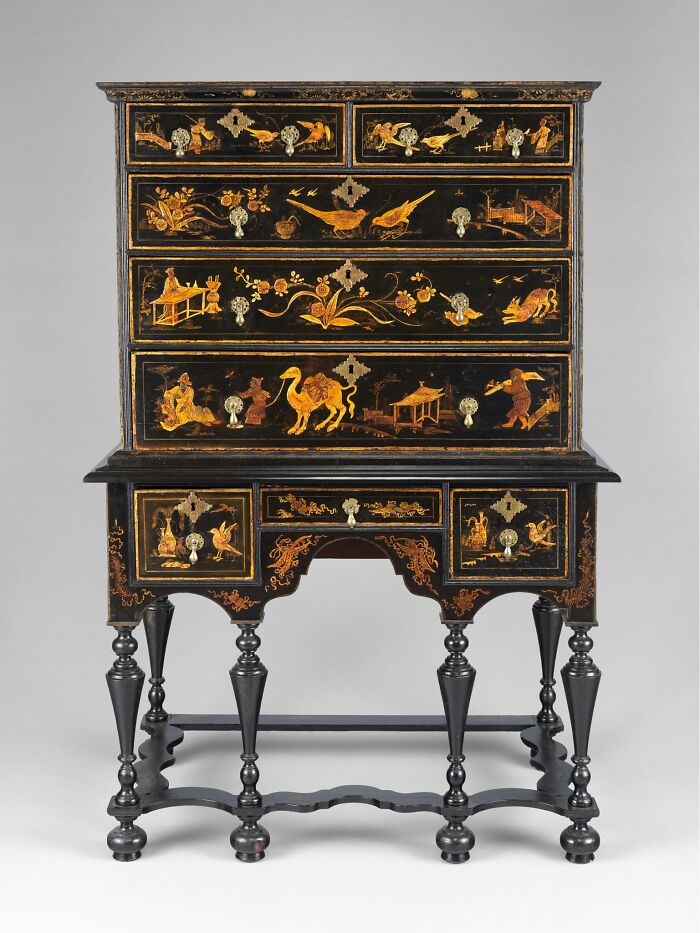
Japanning, a Western imitation of lacquerwork, became fashionable in the colonies after 1700. A stylish surface treatment in which motifs of vaguely Far Eastern origin were raised, gilded, and varnished, japanning was applied to standard furniture forms and, when bright and new, must have produced a dazzling effect. Here the motifs are arranged on a solid black ground in a relaxed, undulating pattern in which people, animals, oversize flowers, and tiny pavilions happily coexist. A new form introduced in the colonies in the 1690s at the same time as the early Baroque style—known in America as the William and Mary style—the high chest of drawers was the most prestigious piece of furniture in the early eighteenth century. Built in separate upper and lower sections, it was characterized in this period by a skirt and stretchers enlivened by curves and turned legs and feet on which bulbous shapes were boldly juxtaposed to narrow tapers. One of the earliest American examples of japanning, this high chest descended in the Pickman family of Boston and Salem.
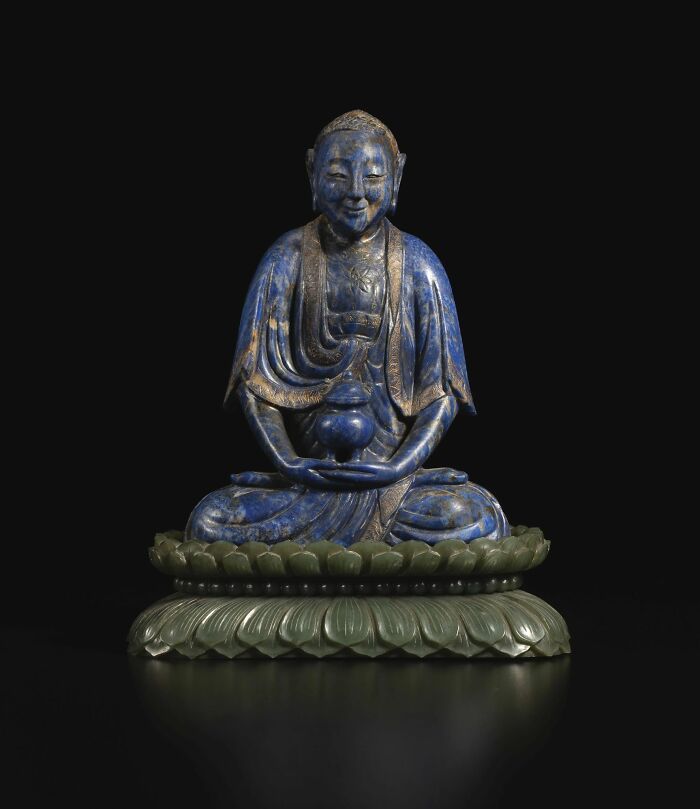
Carved seated in dhyanasana with the hands in dhyana mudra, supporting a four-legged globular censer and cover, wearing draped robes and a dhoti incised at the hems with lotus and chevron borders, heightened with gilding, a necklace with a lotus pendant carved to the bare chest, all supported on a green jade double lotus base. (Height overall 7 1/8 in., 18.2 cm)
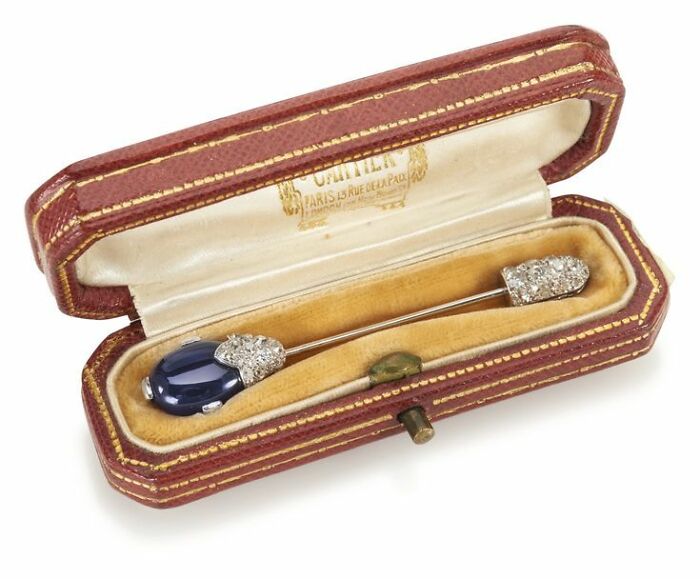
Set with a cabochon sapphire accented with rose-cut diamonds to a circular-cut diamond terminal, signed Cartier, numbered, French assay and maker’s marks, in original red leather case Cartier.
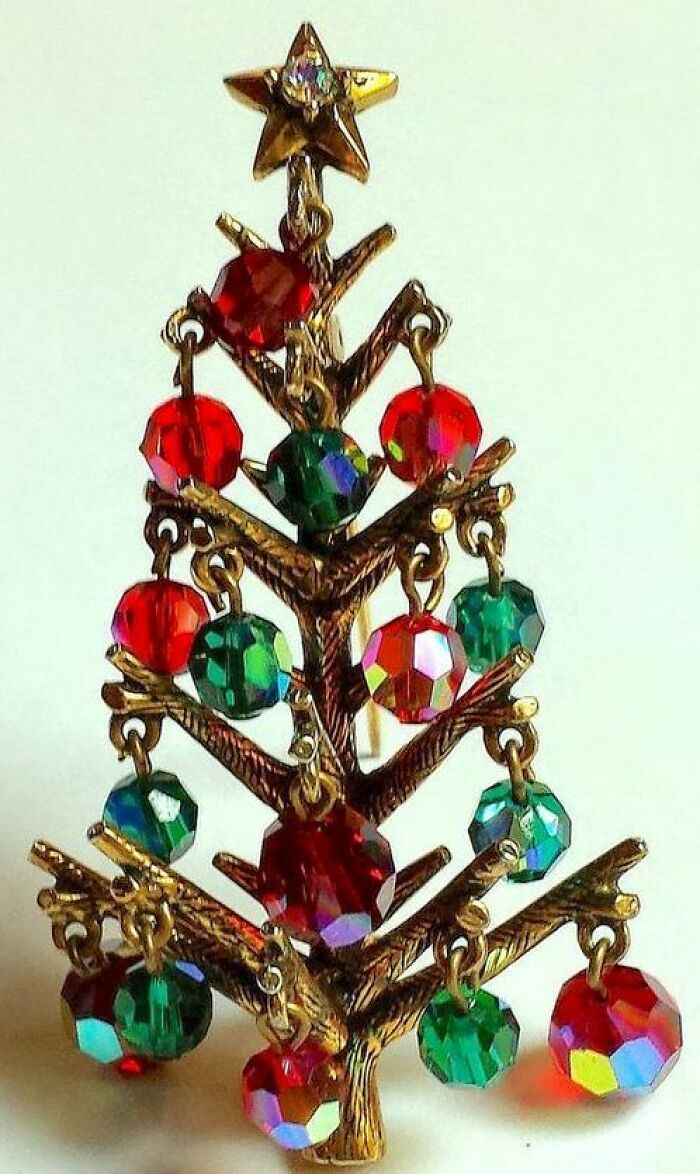
Hollycraft was a vintage costume jewelry brand, produced by the Hollywood Jewelry Manufacturing Company, founded by Joseph Chorbajian in New York City in 1936. The brand name was officially adopted in 1948 and is known for its high-quality, intricate designs featuring colorful, often pastel, rhinestones and enamelwork. The company ceased operations around the late 1970s.
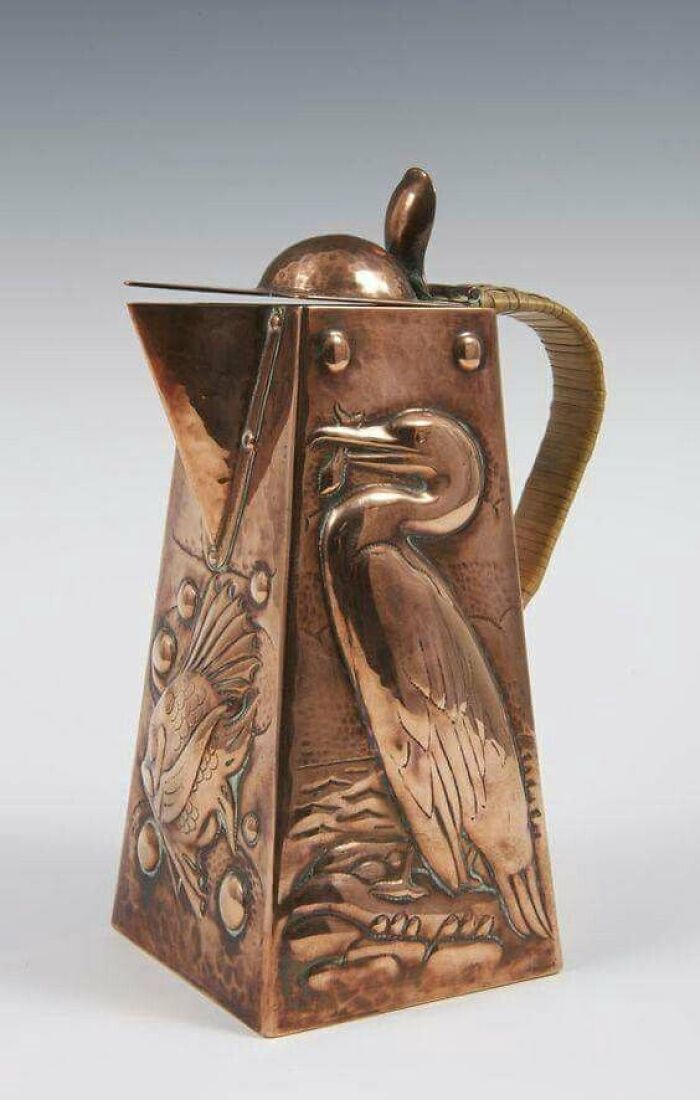
The Newlyn School was an art colony of artists based in or near Newlyn, a fishing village adjacent to Penzance, on the south coast of Cornwall, from the 1880s until the early twentieth century. The establishment of the Newlyn School was reminiscent of the Barbizon School in France, where artists fled Paris to paint in a more pure setting emphasising natural light. These schools along with a related California movement were also known as En plein air.


0 Comments